Written by: Ioana Lungoci, Ioana Ghiurau – Dorcas Romania
In December 2019, the world heard about the first “pneumonia” cases of unknown cause in China. On 7 January 2020, a novel coronavirus was identified: 2019-nCoV.
Since then, the world has changed beyond imagination. Over 6 million people have died[1] and many who contracted the virus are now suffering from the effects of long COVID. The secondary social and economic effects across the world are still hard to fully comprehend.
Healthcare workers were the frontline heroes in the battle against the COVID-19 disease. Organisations around the world responded to decrease the negative impacts of the COVID-19 pandemic on society, especially amongst vulnerable communities.
One of these communities is represented by the Roma people. Roma form the European Union’s largest ethnic minority. While there is no official number for the Romani population worldwide, 10 – 12 million Roma people[2] live in Europe. Approximately 6 million of them reside inside the European Union.
These people, already scarred by extreme racism, social exclusion and poverty, saw their situation worsen under the pandemic.
According to the Second European Union Minorities and Discrimination Survey of 2018, every third Roma child lives in a household where someone went to bed hungry at least once in the previous month. Only 53% of Roma children attend early childhood education. This is typically less than half of the proportion of children their age in the overall population. Between 2011 and 2016, the number of Roma children in segregated, inadequate schooling climbed by half, from 10% to 15%, in just five years[3].
Only 30% of Roma are able to work for a living, compared to the average EU employment rate of 70% in 2015. Furthermore, 41% of Roma report they have been discriminated against in everyday situations, such as looking for work, housing, health and education over the last five years[4].
In this environment, the COVID-19 pandemic has adversely impacted the already challenging lives of Roma communities. During the pandemic, the Roma population continued to endure prejudice and unequal access to essential services. They encountered problems in five areas: housing, health, employment, education, and discrimination.
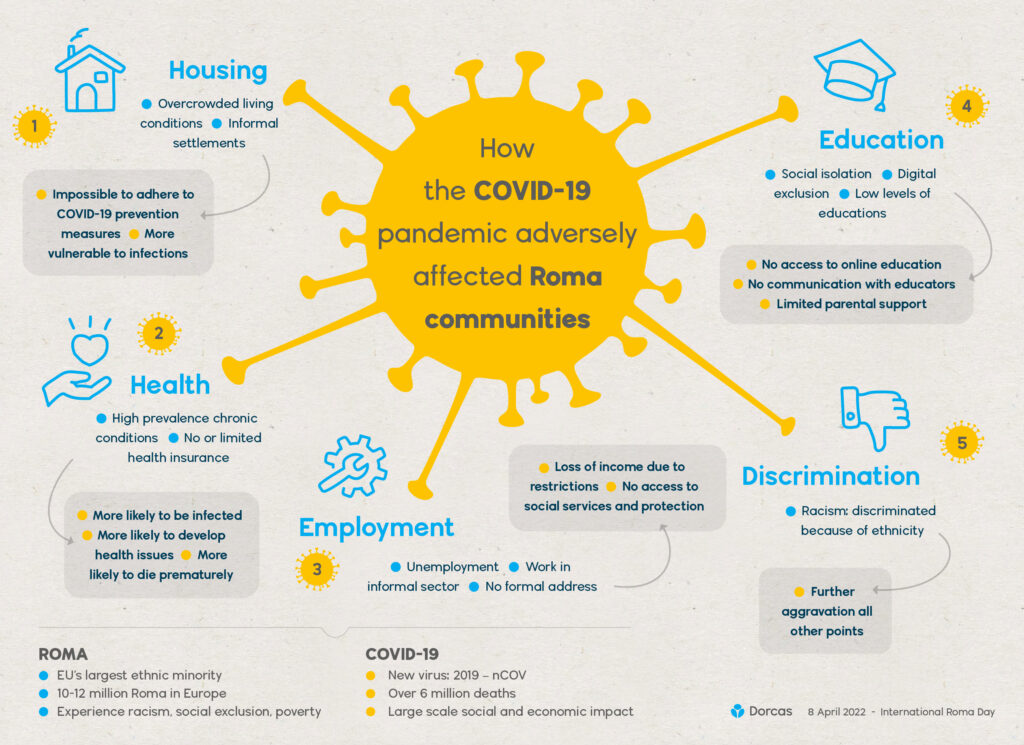
- Housing
Overcrowded living conditions make it impossible for Roma to adhere to hygiene, social distancing and isolation standards in informal settlements. In the European Union, 30% of Roma do not have access to running water and up to 80% live in densely populated areas with overcrowding[5].
2. Health
Due to a high prevalence of long-term chronic conditions, Roma are more likely to not only catch the virus but also to develop health issues and die prematurely.
They face challenges in obtaining healthcare since few have health insurance and the majority reside in segregated neighbourhoods. Many of them are vulnerable to malnutrition, which was already prevalent prior to the pandemic. Their life expectancy is ten years lower on average than that of the general population in the countries where they dwell[6].
3. Employment
Unemployment and low work intensity have long been a problem for Roma, particularly among women. Many Roma lost their daily sources of income and face limited access to social services, which are sometimes made more difficult by quarantine restrictions.
Their daily or occasional job in the informal sector, such as collecting and selling waste materials, small trading, digging in landfills, scavenging for food in garbage cans or even begging, has historically been their source of income. The current situation has driven them even further into poverty. Due to their unstable employment and lack of a formal residential address, Roma were frequently denied social security benefits. Most employment assistance policies to reduce the impact of the COVID-19 crisis impact did not specifically target or include them.
4. Education
Socially isolated and digitally excluded Roma children found it difficult to participate in distance learning. They often lack access to digital media and an internet connection, so they could not follow lessons or communicate with educators. In addition, parents, who often have a low level of education themselves, could not offer educational support.
Many distance-learning programmes need a variety of resources that Roma children rarely have at home. And even if such resources were available, then studying at home in tiny houses with large families was a considerable challenge.
5. Discrimination
Roma continue to endure intolerable levels of prejudice in everyday life, whether they seek a job, are at work or in school, need healthcare, interact with administrative entities, or visit a store. In the past five years, nearly 41% of Roma felt discriminated against in at least one of these areas due to their ethnic origin. However, one-quarter of Roma (26%) say the last incident of perceived discrimination occurred in the 12 months prior to the survey[7].
Racism is common, exacerbated by the fact that many Roma individuals have returned to Eastern Europe after losing their employment due to lockdowns in Western Europe. In some communities, they were even blamed for bringing the virus home with them[8].
[1]https://www.economist.com/graphic-detail/coronavirus-excess-deaths-estimates
[2]https://ec.europa.eu/info/policies/justice-and-fundamental-rights/combatting-discrimination/roma-eu/roma-equality-inclusion-and-participation-eu_en
[3]https://fra.europa.eu/en/publication/2016/second-european-union-minorities-and-discrimination-survey-roma-selected-findings
[4]https://fra.europa.eu/en/publication/2016/second-european-union-minorities-and-discrimination-survey-roma-selected-findings
[5] Roma in the COVID-19 crisis: An early warning from six EU Member States – Italy | ReliefWeb
[6] https://www.eesc.europa.eu/en/news-media/presentations/roma-health
[7] https://fra.europa.eu/sites/default/files/fra_uploads/fra-2016-eu-minorities-survey-roma-selected-findings_en.pdf
[8] https://www.euractiv.com/section/coronavirus/opinion/the-roma-are-among-most-threatened-by-covid-19-in-europe/
Seventy per cent of the 1.3 billion people living in conditions of poverty are women. In urban areas, 40 per cent of the poorest households are headed by women. Women predominate in the world’s food production (50-80 per cent), but they own less than 10 per cent of the land. Eighty per cent of the displaced by climate related disasters and changes around the world are women and girls. Climate change may lead to more gender-based violence, an increase in child marriages, and worsening sexual and reproductive health.
Looking at these data published by the United Nations, it would be easy to view women – and in particular older women – as victims. Dorcas has a different message on International Women’s Day.
Women are not helpless victims, but they do experience – more than others – the impact of injustice and gender inequality. Advancing gender equality in the context of the climate crisis and disaster risk reduction is one of the greatest global challenges of the 21st century. Women are increasingly being recognised as more vulnerable to climate change impacts than men, as they constitute the majority of the world’s poor and are more dependent on the natural resources which climate change threatens the most.
At the same time, women and girls are effective and powerful leaders and change-makers for climate adaptation and mitigation. They are involved in sustainability initiatives around the world, and their participation and leadership results in more effective climate action.
Every day Dorcas meets strong older women who live in difficult circumstances. A current example are Ukrainian women who for the past week daily cross the border with Romania to help and comfort those who flee from the war in Ukraine. At the end of each day, they return to their own homes in Ukraine.
Despite their circumstances, these women have chosen to empower others and to help them develop – not only themselves, but also the people around them. These women use their strength to advocate for changes in their communities, on an economic, social and political level. Women such as Nabila from Lebanon, Ana from Moldova and Martha from Tanzania inspire us with their resourcefulness, their hope and their resilience. You can read their portraits on the Portraits of Power website.
Structural injustice and gender inequality leading to poverty, marginalisation, stereotyping and discrimination of women – and in particular older women – needs to be unpacked and called out for what it is: unjust. All of us need to recognise that women are the ones that across the globe daily experience the subtle and overt effects of injustice and gender inequality. Most importantly all of us need to live out the fact that we all have a role to play in addressing this injustice and gender inequality. And that women – in particular older women – are the ones that lead the way in this when we listen and pay attention. Without gender equality today, a sustainable future, and an equal future, remains beyond our reach.
Meet Jane (57), a strong senior woman from Tanzania – a country known for its beautiful wildlife reserves and for being home to a large variety of ecological systems ranging from Alpine deserts to rainforest areas. Tanzanian women are generally marginalised, a fact that is even more often the case for older women. Older women are usually impoverished, stigmatised and they have limited access to healthcare. Be inspired her story of courage and creativity as she stands strong in the face of poverty and the effects of HIV/AIDS.
“You never know how strong you are until being strong is your only option”
Jane, Tanzania
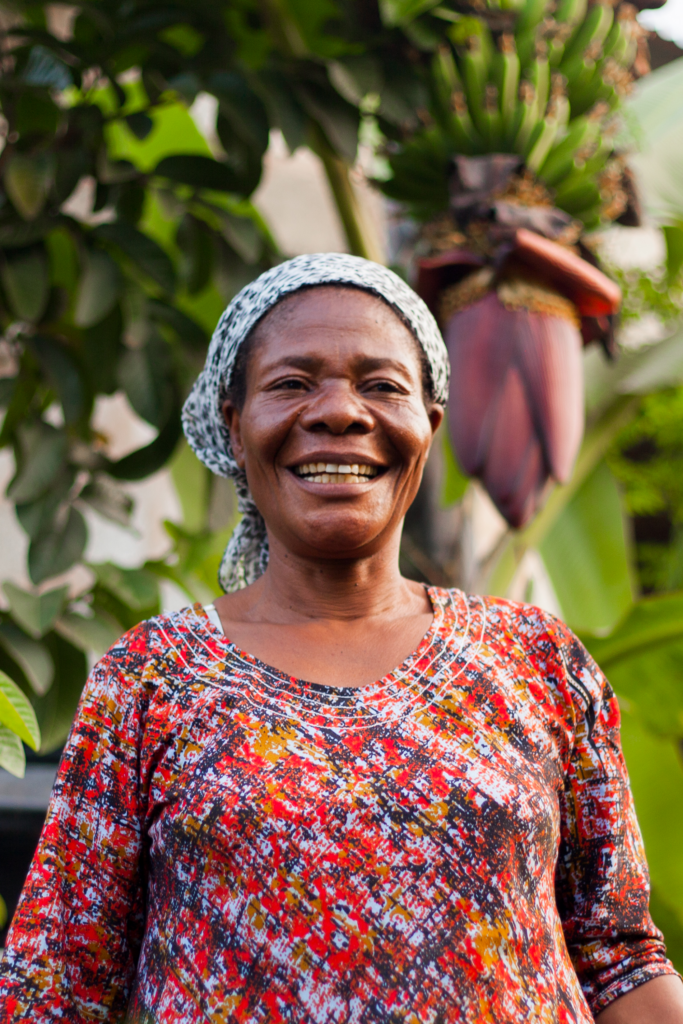
My name is Jane and in 1995, my life changed completely. My husband passed when I was pregnant with our fourth child. We seemed to have a good life – I was married to a soldier, we were blessed with wonderful, healthy children and we lived in an apartment on the military base in Monduli. We had hopes and dreams, just like any other couple.
But, shortly after the funeral, I discovered that my husband had died from AIDS. I was tested and my results came out positive. I felt utterly crushed. Nobody knew anything about HIV in those days, most of the information we had at the time was false. We did hear a lot of rumours and these rumours turned victims into outcasts.