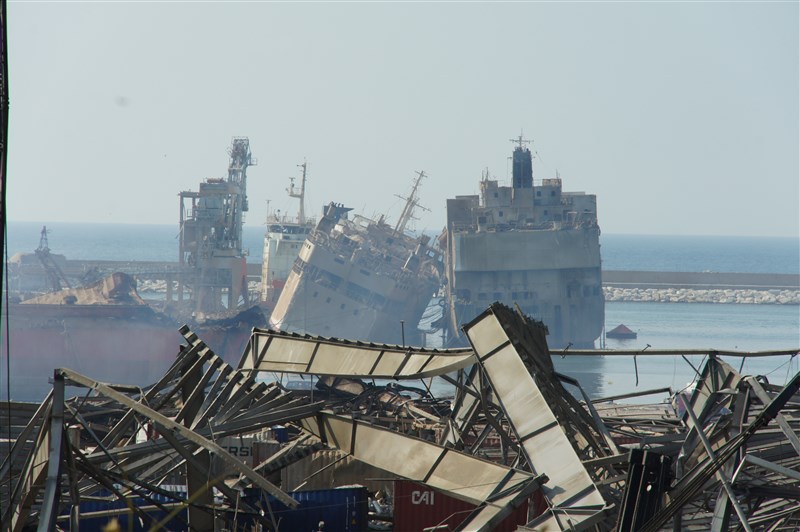
The Beirut blast on August 4 2020, was one of the largest explosions in history that pulverised the port, and damaged over half of Beirut. The explosion had a significant impact on the country which reverberates to this day. The economic and political situation worsens, and more and more Lebanese become dependent on aid.
Dorcas Lebanon launched a livelihood project in response to the Beirut blast. The project supports micro and small businesses affected by the blast in Bourj Hammoud and Achrafieh. The project focusses especially on male and female technicians and artisans working in local value chains, both experienced and recently graduated. The project aims to strengthen the economic resilience of a selected group of entrepreneurs, giving priority to youth and women led businesses. At least 40 percent of the total number of project participants will be female entrepreneurs.
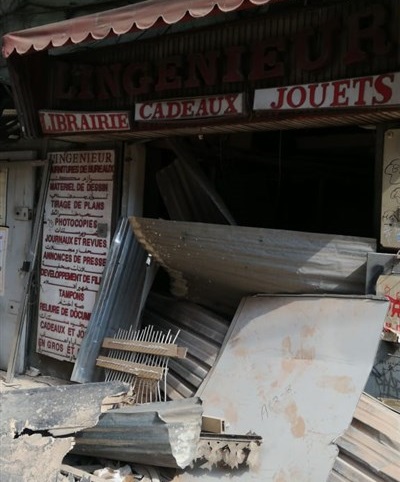
The Micro, Small and Medium Enterprises project targets existing businesses that have not been able to recover and stabilise their business after the blast. It will provide participating entrepreneurs with training, tools and business support to strengthen their livelihood and life skills.
The project will support:
- 40 business owners in the beauty, art, hospitality, sports and crafts sectors and local value chains. How? Through in-kind support for repairing their shops, buying tools and equipment.
- 10 experienced technicians. How? Through tools to start and improve their work.
- 10 freshly graduated technicians. How? Through a support package of tools related to their major business activity. And in addition, through training and coaching on life and entrepreneurial skills.
- 5 youth specialised in digital services. How? This group will provide digital services support to project participants and receive incentives in exchange.
- 40 women from the area of the blast who will participate in sewing and entrepreneurial skills trainings.
- 20 young people from the area of the blast who will participate in a training to obtain a ‘Brevet d’Aptitude aux Fonctions d’Animateur’ or childcare aptitude certificate. This will allow them to undertake psychosocial support activities for children in their community.
Duration project: June 2022 till September 2023
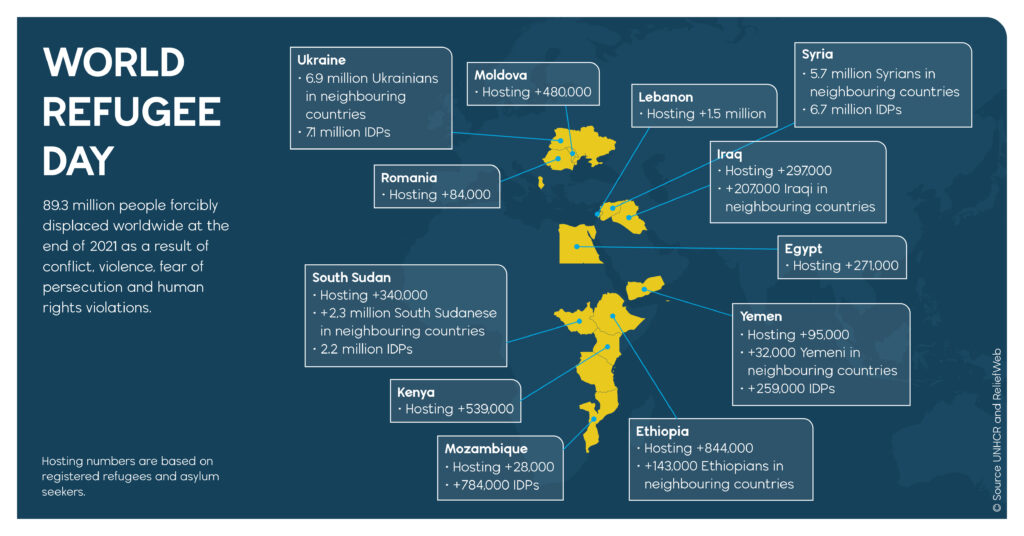
89.3 million forcibly displaced worldwide
- 69% originated from just 5 countries (including 2 countries where Dorcas is active; Syria and South Sudan)
- 83% hosted in low- and middle-income countries
(Source: Global Trends Report UNHCR end 2021)
Dorcas is active in 14 countries in Eastern Europe, Eastern Africa and the Middle East. We see the effect of the continuously growing numbers of people forced to flee. In 12 of those 14 countries we see forcibly displaced people. One of the recent examples is Ukraine.
UNHCR states that with millions of Ukrainians displaced and further displacement elsewhere in 2022, the total forced displacement now exceeds 100 million people. This means 1 in every 78 people on earth has been forced to flee – a dramatic milestone.
Lebanon experiences the effects of the ongoing conflict in Syria. Lebanon is hosting the largest number of refugees per capita, with an estimation of 1.5 million Syrian refugees plus some 13,617 refugees of other nationalities.
In South Sudan, 2 million people are internally displaced due to conflict, insecurity and the impact of climate change. The crisis in South Sudan remains the largest refugee crisis in Africa.
In Syria around 6.7 million people are internally displaced, some of whom have been displaced multiple times.
- A refugee is someone who fled his or her home and country owing to “a well-founded fear of persecution because of his/her race, religion, nationality, membership in a particular social group, or political opinion”, according to the United Nations 1951 Refugee Convention. Many refugees are in exile to escape the effects of natural or human-made disasters.
- Asylum seekers say they are refugees and have fled their homes as refugees do, but their claim to refugee status is not yet definitively evaluated in the country to which they fled.
- Internally Displaced Persons (IDPs) are people who have not crossed an international border but have moved to a different region than the one they call home within their own country.
Source UNHCR and ReliefWeb
Dorcas invests in resilient communities in which everyone can make their contribution. When a disaster or a crisis occurs, we provide assistance and we support communities to rebuild themselves. At the same time, we invest in structural remedies for poverty and social exclusion. We do this by encouraging entrepreneurship, self-reliance, and protection of people in vulnerable circumstances.
If there was any year in recent history where the importance of resilience was underlined, it was 2021. On a global scale! The COVID-19 pandemic continued to take its toll and surprised us time and again with its twists and turns as well as its secondary effects on society. Existing societal cracks became deeper and wider, and new ones emerged, resulting in sharper divisions and growing imbalances. Its impact could be felt in many public sectors, communities, and our lives. The degree of severity varied and was dependent on a person’s social status and where they lived. It became abundantly clear across the world: self-esteem and resilience are essential for maintaining hope and perspective in difficult times. And they are also the core elements of our interventions.
How did we manage? Read our 𝐀𝐧𝐧𝐮𝐚𝐥 𝐑𝐞𝐩𝐨𝐫𝐭.
2021 Saw Dorcas grow in partnering for change for realising change. Our collective efforts reached and impacted almost 930,000 persons in 14 countries in Africa, Eastern Europe and the Middle East.
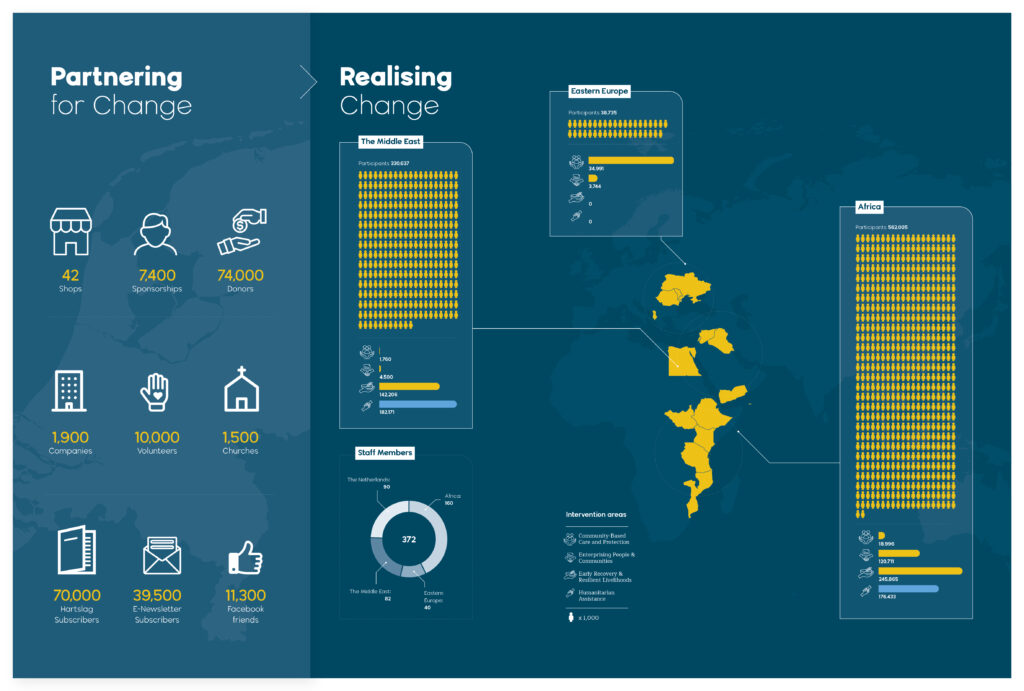
The annual report is meant to be a transparent look in to the ‘kitchen’ of Dorcas. You will read how and with who Dorcas has contributed to sustaining change in extraordinary times in 2020. Reading the report will give you the opportunity to learn from our successes and failures. Reading the report will help you to look beyond the ‘numbers’ and discover how change has taken place in the lives of individual people, communities and the societies they live in.
Contact us
When you have read the annual report, contact Dorcas! Get in touch! Let us know what we can do better. How can we work together to make sure no one is left behind and lasting impact is created in extraordinary times, for all and by all?
Agnes Kroese will become the new CEO of Dorcas with effect from 1 September 2022. In her role as Country Director South Sudan, she has been actively involved with Dorcas since 2019. Agnes has held various positions within the humanitarian and development sector and has a strong track record. She succeeds Leo Visser, who will retire at the end of September after leading Dorcas for six years.
Agnes looks forward to continuing her career at Dorcas as CEO and also Chairman of the Executive Board. Agnes: ‘From close up, I have experienced what Dorcas’ work means for those in need. The change in individuals and the flourishing of communities motivates me and gives me hope. I want to use my knowledge and experience to further develop and professionalise Dorcas, so that, together with everyone involved, we can realise a structural impact on even more lives.’
Jan van der Linden, Chair of the Supervisory Board and responsible for the recruitment process: ‘In Agnes, we have found someone with the right qualities, ambition and inspiration to become Dorcas’ new CEO. With great personal commitment, she has been a strong leader of Dorcas’ work in South Sudan over the past few years. In her new role, Agnes will work with the entire team to give substance to Dorcas’ further development.’
Leo Visser will hand over his responsibilities to Agnes in September and retire on 1 October after a meaningful career. Dorcas is grateful for Leo’s unbridled commitment and his continuous investment in sustainable change. Thanks to his efforts, Dorcas is now a stable, future-oriented organisation that is able to act decisively for those in need, also in these exceptional times.
Besides Leo Visser’s departure, Dorcas will also bid farewell to Ine Voorham. She has been actively involved as Chair of the Supervisory Board since 2012. After a period of 10 years, her involvement with Dorcas has come to an end. Ine Voorham has played a pivotal role at crucial moments, for which Dorcas is very grateful. Jan van der Linden has been appointed as her successor. He has been a member of the Supervisory Board since 2016 and he has been appointed Chairman of the Supervisory Board with effect from 15 May 2022.
When working on cash programmes it can be an overabundance of information for aid workers with a lot of admin work and time spend on aligning with fellow team members. These programmes in addition tend to change often which can cause a challenge for keeping all documents updates. The Cash Program Design Wizard is a simple web-based tool that helps humanitarian organisations to design cash programmes in line with international standards and best practices and address challenges based on real experiences across multiple contexts. Its main purpose is to guide aid workers through a simple set of intuitive questions that results in a quality cash program. It does so by starting with the reality of the human context rather than the cash solution, reducing uncertainty on cash program parameters and it increases the speed to set up usage across locations and organisations.
The Design Process
25 Aid workers from the consortium partners of Dorcas, ZOA, Help a Child, Tearfund, Cordaid and 510 (Data & Digital initiative of The Netherlands Red Cross) have co-designed the Cash Program Design Wizard. The Cash Program Design Wizard was co-designed using Human Centered Design methodologies. Human Centered Design is a design and management framework that develops solutions to problems by involving the human perspective in all steps of identifying the problem and solution process which is applied in the co-design sessions.
In 2021 co-design sessions were held across Burundi, DRC, Ethiopia, Iraq, Lebanon, South Sudan, Syria and Yemen. In total 25 aid workers shared their experience with cash programming. In 2022 some of these co-designers user tested and improved the product linking it to real cash programmes. From 2018 until 2022 there were many other aid workers that co-designed the Cash Program Design Wizard sharing their learnings and needs as aid workers asked to set up cash programmes including people affected. These sessions included many disaster response types across the Caribbean, Ukraine, Malawi, Kenya, The Netherlands, Chad, Lesotho, Namibia and Nigeria. Together we looked at the tools, trainings and processes that aid workers found useful within their organisation and we clustered their challenges.
The needs and challenges of the aid worker
The Cash Program Design Wizard is created across 3 different aspects: desirability of the humans involved (including people affected), the feasibility of the technological and the viability within the humanitarian context. The needs and challenges of the aid worker expressed during the co-design sessions can be concluded into the following:
- “We would like to have guidelines, policies and tools, but not an information overload! A tool that is not telling you what to do… but facilitating on how to do it!” (desirability of the human)
- “We often are not reachable during office hours when in the field and have poor connectivity….but we need to make sure we are aligned with headquarters and the other members of the team across different working hours” (feasibility technological)
- “Things change so often when planning a cash program and often we have to change many documents to keep them up to date and realign with the other team members….” (viability humanitarian)
The benefits of the Cash Program Design Wizard
The learnings of the co-design sessions were incorporated into the Cash Program Wizard. The Cash Program Design Wizard provides the following benefits:
- Easier: It’s a total package tool and provides guidance through the program for both inexperienced and experienced aid workers to create quality cash programmes.
- Faster: It delivers an outcome report that is instantly useable.
- Faster: It saves admin time and enables alignment across a wider team.
- Easier: It has an online and offline function to ensure no loss of data.
The Cash Program Design Wizard helps aid workers in field offices, country offices and (inter)national headquarters, who want to set up cash programming for people affected within multiple contexts. The tool allows one main owner of the program design (often a Field Officer) to flow through the guiding questions, answering them and changing those answers as and when needed. The latest information automatically updates a standard report structure ensuring that there is one central point of truth on the program design at any given time. A comment section per question allows for other stakeholders in the country office or (inter)national headquarters to input on the latest design or simply stay up to date on the latest status.
The 121 Platform
The 121 platform consists of easy-to-use Cash-Based Aid products for people affected, and aid workers alike in response to the increasing global demand for cash and voucher-based aid in the humanitarian sector (such as the Self Registration App and Humanitarian Organisation Portal). To ensure its scalability the Cash Program Design Wizard has been created to function outside of the 121 Platform. If an organisation has designed the cash program with the Cash Program Design Wizard, they can also consider using the 121 platform. Through the 121 Platform they can ensure that people receive Cash and Voucher Assistance in an easy, safe and fast way. Read more about the 121 Platform here.
The consortium
The development of the Cash Program Design Wizard by the consortium (Dorcas, ZOA, Help a Child, Tearfund, Cordaid and 510) is made possible by funding of the Dutch Relief Alliance through the DRA Innovation Fund. The Dutch Relief Alliance Innovation Fund is a fund created by the Dutch Relief Alliance with financial support of the Dutch Ministry of Foreign Affairs. The Dutch Relief Alliance operates at a global level through an alliance of Dutch humanitarian organisations and in partnership with the Netherlands Ministry of Foreign Affairs since 2015. They work together with more than 100 local organisations.
Written by: Ioana Lungoci, Ioana Ghiurau – Dorcas Romania
In December 2019, the world heard about the first “pneumonia” cases of unknown cause in China. On 7 January 2020, a novel coronavirus was identified: 2019-nCoV.
Since then, the world has changed beyond imagination. Over 6 million people have died[1] and many who contracted the virus are now suffering from the effects of long COVID. The secondary social and economic effects across the world are still hard to fully comprehend.
Healthcare workers were the frontline heroes in the battle against the COVID-19 disease. Organisations around the world responded to decrease the negative impacts of the COVID-19 pandemic on society, especially amongst vulnerable communities.
One of these communities is represented by the Roma people. Roma form the European Union’s largest ethnic minority. While there is no official number for the Romani population worldwide, 10 – 12 million Roma people[2] live in Europe. Approximately 6 million of them reside inside the European Union.
These people, already scarred by extreme racism, social exclusion and poverty, saw their situation worsen under the pandemic.
According to the Second European Union Minorities and Discrimination Survey of 2018, every third Roma child lives in a household where someone went to bed hungry at least once in the previous month. Only 53% of Roma children attend early childhood education. This is typically less than half of the proportion of children their age in the overall population. Between 2011 and 2016, the number of Roma children in segregated, inadequate schooling climbed by half, from 10% to 15%, in just five years[3].
Only 30% of Roma are able to work for a living, compared to the average EU employment rate of 70% in 2015. Furthermore, 41% of Roma report they have been discriminated against in everyday situations, such as looking for work, housing, health and education over the last five years[4].
In this environment, the COVID-19 pandemic has adversely impacted the already challenging lives of Roma communities. During the pandemic, the Roma population continued to endure prejudice and unequal access to essential services. They encountered problems in five areas: housing, health, employment, education, and discrimination.
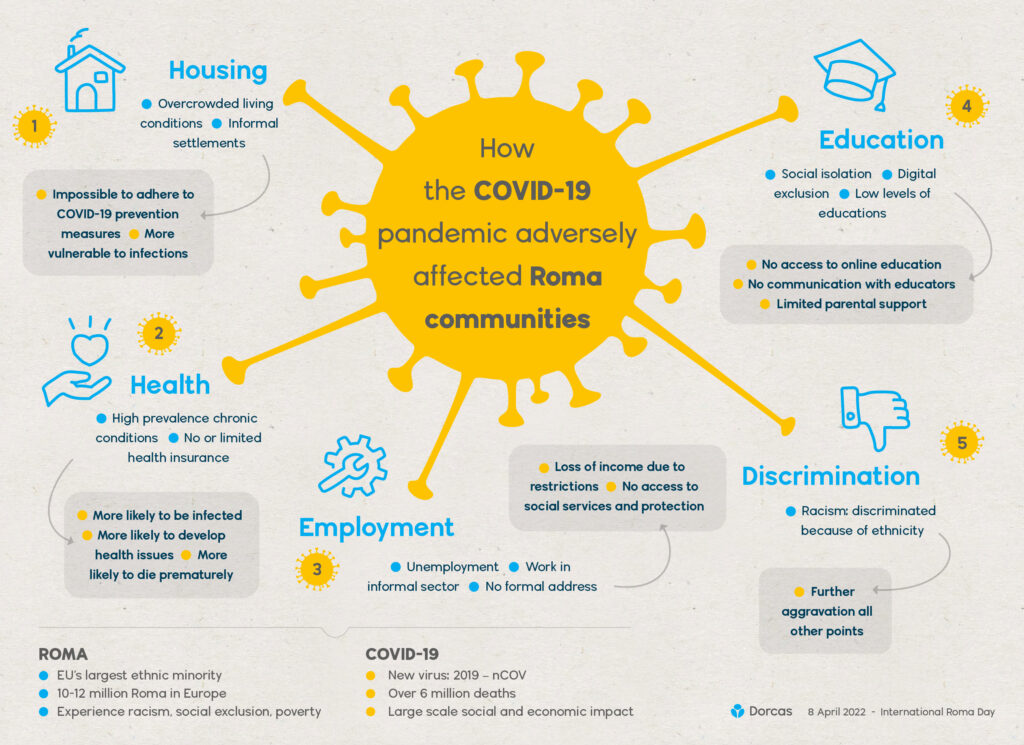
- Housing
Overcrowded living conditions make it impossible for Roma to adhere to hygiene, social distancing and isolation standards in informal settlements. In the European Union, 30% of Roma do not have access to running water and up to 80% live in densely populated areas with overcrowding[5].
2. Health
Due to a high prevalence of long-term chronic conditions, Roma are more likely to not only catch the virus but also to develop health issues and die prematurely.
They face challenges in obtaining healthcare since few have health insurance and the majority reside in segregated neighbourhoods. Many of them are vulnerable to malnutrition, which was already prevalent prior to the pandemic. Their life expectancy is ten years lower on average than that of the general population in the countries where they dwell[6].
3. Employment
Unemployment and low work intensity have long been a problem for Roma, particularly among women. Many Roma lost their daily sources of income and face limited access to social services, which are sometimes made more difficult by quarantine restrictions.
Their daily or occasional job in the informal sector, such as collecting and selling waste materials, small trading, digging in landfills, scavenging for food in garbage cans or even begging, has historically been their source of income. The current situation has driven them even further into poverty. Due to their unstable employment and lack of a formal residential address, Roma were frequently denied social security benefits. Most employment assistance policies to reduce the impact of the COVID-19 crisis impact did not specifically target or include them.
4. Education
Socially isolated and digitally excluded Roma children found it difficult to participate in distance learning. They often lack access to digital media and an internet connection, so they could not follow lessons or communicate with educators. In addition, parents, who often have a low level of education themselves, could not offer educational support.
Many distance-learning programmes need a variety of resources that Roma children rarely have at home. And even if such resources were available, then studying at home in tiny houses with large families was a considerable challenge.
5. Discrimination
Roma continue to endure intolerable levels of prejudice in everyday life, whether they seek a job, are at work or in school, need healthcare, interact with administrative entities, or visit a store. In the past five years, nearly 41% of Roma felt discriminated against in at least one of these areas due to their ethnic origin. However, one-quarter of Roma (26%) say the last incident of perceived discrimination occurred in the 12 months prior to the survey[7].
Racism is common, exacerbated by the fact that many Roma individuals have returned to Eastern Europe after losing their employment due to lockdowns in Western Europe. In some communities, they were even blamed for bringing the virus home with them[8].
[1]https://www.economist.com/graphic-detail/coronavirus-excess-deaths-estimates
[2]https://ec.europa.eu/info/policies/justice-and-fundamental-rights/combatting-discrimination/roma-eu/roma-equality-inclusion-and-participation-eu_en
[3]https://fra.europa.eu/en/publication/2016/second-european-union-minorities-and-discrimination-survey-roma-selected-findings
[4]https://fra.europa.eu/en/publication/2016/second-european-union-minorities-and-discrimination-survey-roma-selected-findings
[5] Roma in the COVID-19 crisis: An early warning from six EU Member States – Italy | ReliefWeb
[6] https://www.eesc.europa.eu/en/news-media/presentations/roma-health
[7] https://fra.europa.eu/sites/default/files/fra_uploads/fra-2016-eu-minorities-survey-roma-selected-findings_en.pdf
[8] https://www.euractiv.com/section/coronavirus/opinion/the-roma-are-among-most-threatened-by-covid-19-in-europe/
Dorcas and ZOA are joining forces and will form a partnership in South Sudan. Both organisations have been present in South Sudan for many years and have worked closely together during those years. Per April 1st 2022, Dorcas and ZOA will form a joint working organisation under the name ‘ZOA Dorcas South Sudan’ with a country office in Juba.
“Our complementary expertise and geographical coverage enables us to achieve more impact in reaching those most affected by crisis and poverty in the country”.
Agnes Kroese, country director ZOA Dorcas South Sudan.
The current programmes in the country are not affected by this organisational change, these will continue as planned. The partnership focuses on South Sudan, the international offices of both organisations as well as offices in other countries remain independent entities.
In the past weeks, an estimated 12.65 million people have been affected in the areas hardest hit by the war within Ukraine. About 3 million refugees have fled the country and another 1.85 million people are internally displaced. Many more remain trapped in areas of escalating conflict where essential services are disrupted, and basic needs such as food, water and medicines can scarcely be met. In the face of this human catastrophe, Dorcas seeks to identify the most vulnerable groups and provide them with shelter, food, medical aid and other basic care. These include persons with disabilities, older people and people at risk of human trafficking.
Persons with disabilities
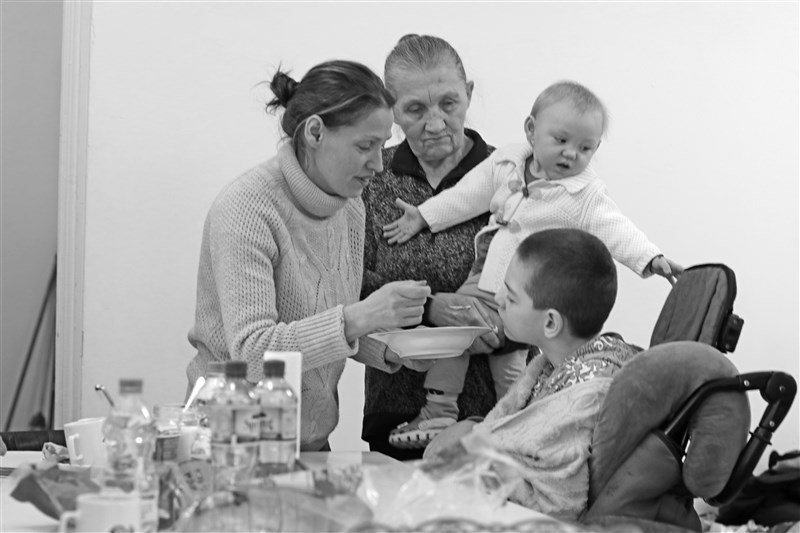
About 3 million persons with disabilities live in Ukraine. They face multiple barriers in accessing safe evacuation, shelter and humanitarian assistance. For example, shelters like metro stations and bunkers are often inaccessible for persons who use wheelchairs. And blind and deaf persons experience difficulties accessing information on emergency evacuation and shelter locations. Therefore, many people with disabilities are forced to stay at home when shelling occurs. Furthermore, thousands of children and adults with disabilities are trapped in institutions where they face the risk of being abandoned or suffering serious neglect.
Older people
Older people are also disproportionately harmed by the war, especially older women and people with disabilities or chronic diseases. They face difficulties in escaping or avoiding fighting, which means they can become separated from their family. Access to the healthcare, medicines and assistive devices (such as walking frames and toilet chairs) they need can also be severely curtailed. And where humanitarian support and targeted services are available, older people often fail to access these because they are unable to wait in the long queues for hours.
Risk of trafficking
Finally, refugees run the risk of human trafficking. Displaced persons may have limited access to financial resources or opportunities for income generation. That gives traffickers a fertile environment to promise safe migration routes, employment and education or skills training. Refugees are then deceived into entering exploitative situations to pay off the smuggler fees. Children who are displaced or separated from their families without support networks are particularly vulnerable to becoming targets for traffickers.
Heavy conflict in Ukraine threatens the lives and livelihoods of hundreds of thousands of people across the country. The violence has destroyed homes, torn families apart and damaged essential services. Many lives have already been lost.
Hundreds of thousands are trapped in conflict areas, cut off from food, clean drinking water, electricity and health services. More than 2 million people have fled the country in the past days. The UN projects that millions more will be displaced from their homes by escalating violence.
Acute Joint Response Ukraine
The Dutch Relief Alliance (DRA) initiated an Acute Joint Response in Ukraine to provide immediate humanitarian relief to victims of the conflict and support communities that host displaced people. The Joint Response, led by Dorcas in cooperation with Cordaid and Save the Children, works with local partners in Ukraine to deliver urgent support such as food parcels, nonfood items for shelters, clean drinking water, hygiene kits to those affected, focusing in particular on the areas in and around Poltava, Ternopil, Kyiv, Ivano-Frankivsk, Transcarpathia and Zaporishya.
In the next 6 months, the DRA will improve shelters for displaced people by providing mattresses, blankets and cooking supplies. The DRA offers psychosocial support and mental healthcare to help victims deal with stress and trauma resulting from the conflict. Support to marginalised people, such as people with a disability, older persons, pregnant women, children and vulnerable families is central to the response.
Flexible, immediate response
The DRA is able to respond rapidly to the crisis in Ukraine due to the DRA partnership with the Dutch Ministry of Foreign Affairs, which provides direct funding for Joint Responses. Humanitarian support is delivered by DRA members together with local organisations in Ukraine.
About the Dutch Relief Alliance
The Dutch Relief Alliance (DRA) is a coalition of 14 Dutch aid organisations in partnership with the Netherlands Ministry of Foreign Affairs. The DRA partners are: CARE Nederland; Cordaid; Dorcas; Oxfam Novib; Plan International; Help a Child; Save the Children; SOS Children’s Villages The Netherlands; Stichting Vluchteling; Tearfund NL; Terre des Hommes; War Child; World Vision; and ZOA. The Netherlands Ministry of Foreign Affairs (BZ) partners with the DRA by funding Joint Responses.
Seventy per cent of the 1.3 billion people living in conditions of poverty are women. In urban areas, 40 per cent of the poorest households are headed by women. Women predominate in the world’s food production (50-80 per cent), but they own less than 10 per cent of the land. Eighty per cent of the displaced by climate related disasters and changes around the world are women and girls. Climate change may lead to more gender-based violence, an increase in child marriages, and worsening sexual and reproductive health.
Looking at these data published by the United Nations, it would be easy to view women – and in particular older women – as victims. Dorcas has a different message on International Women’s Day.
Women are not helpless victims, but they do experience – more than others – the impact of injustice and gender inequality. Advancing gender equality in the context of the climate crisis and disaster risk reduction is one of the greatest global challenges of the 21st century. Women are increasingly being recognised as more vulnerable to climate change impacts than men, as they constitute the majority of the world’s poor and are more dependent on the natural resources which climate change threatens the most.
At the same time, women and girls are effective and powerful leaders and change-makers for climate adaptation and mitigation. They are involved in sustainability initiatives around the world, and their participation and leadership results in more effective climate action.
Every day Dorcas meets strong older women who live in difficult circumstances. A current example are Ukrainian women who for the past week daily cross the border with Romania to help and comfort those who flee from the war in Ukraine. At the end of each day, they return to their own homes in Ukraine.
Despite their circumstances, these women have chosen to empower others and to help them develop – not only themselves, but also the people around them. These women use their strength to advocate for changes in their communities, on an economic, social and political level. Women such as Nabila from Lebanon, Ana from Moldova and Martha from Tanzania inspire us with their resourcefulness, their hope and their resilience. You can read their portraits on the Portraits of Power website.
Structural injustice and gender inequality leading to poverty, marginalisation, stereotyping and discrimination of women – and in particular older women – needs to be unpacked and called out for what it is: unjust. All of us need to recognise that women are the ones that across the globe daily experience the subtle and overt effects of injustice and gender inequality. Most importantly all of us need to live out the fact that we all have a role to play in addressing this injustice and gender inequality. And that women – in particular older women – are the ones that lead the way in this when we listen and pay attention. Without gender equality today, a sustainable future, and an equal future, remains beyond our reach.
Meet Jane (57), a strong senior woman from Tanzania – a country known for its beautiful wildlife reserves and for being home to a large variety of ecological systems ranging from Alpine deserts to rainforest areas. Tanzanian women are generally marginalised, a fact that is even more often the case for older women. Older women are usually impoverished, stigmatised and they have limited access to healthcare. Be inspired her story of courage and creativity as she stands strong in the face of poverty and the effects of HIV/AIDS.
“You never know how strong you are until being strong is your only option”
Jane, Tanzania
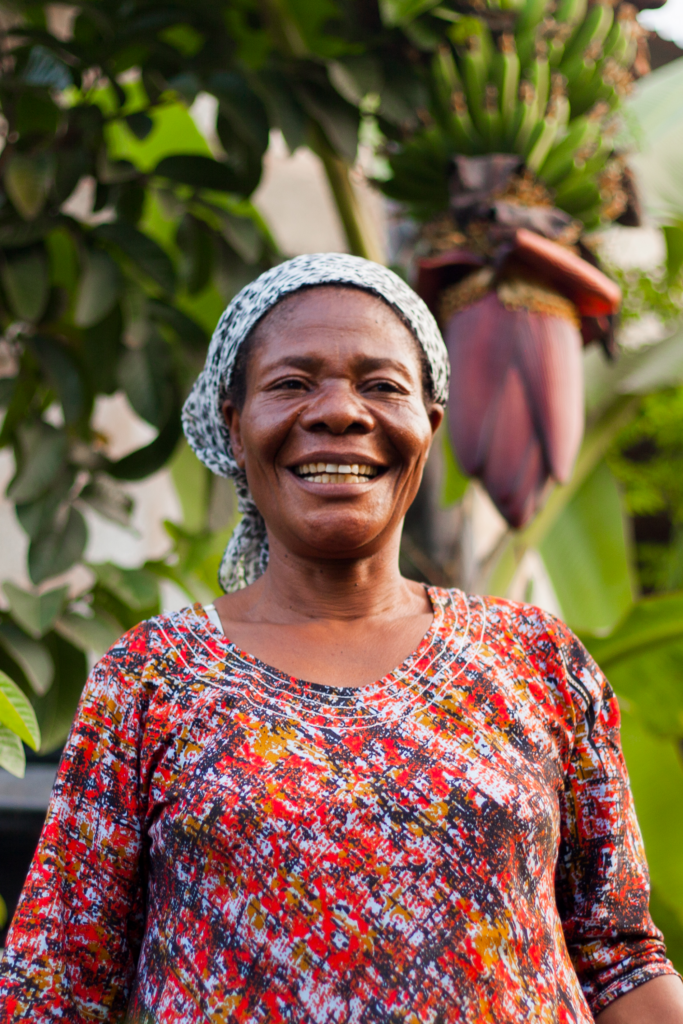
My name is Jane and in 1995, my life changed completely. My husband passed when I was pregnant with our fourth child. We seemed to have a good life – I was married to a soldier, we were blessed with wonderful, healthy children and we lived in an apartment on the military base in Monduli. We had hopes and dreams, just like any other couple.
But, shortly after the funeral, I discovered that my husband had died from AIDS. I was tested and my results came out positive. I felt utterly crushed. Nobody knew anything about HIV in those days, most of the information we had at the time was false. We did hear a lot of rumours and these rumours turned victims into outcasts.
Home EN