Wim van Dorp (71) from Delft took part in the Nijmegen Four Days Marches for the 40th time this year. With his participation in the walking event, he raises money for Dorcas every year. This year, he walked for water projects in Kenya.
‘Everything went very well. On to next year!’ Wim reflects on the 2025 edition.
With his participation, Wim has raised over 2,000 euros for Dorcas’s water projects in Kenya. ‘Water is the most important thing a person needs. You can nicely link that to the Nijmegen Four Days Marches; drinking enough water always plays a big role there, too.’
Wim started walking the Nijmegen Four Days Marches forty years ago, encouraged by his father, who had already been taking part for years. ‘I thought walking was more for children or old people, not for a young lad like me,’ Wim says. Yet his father persuaded him, and he joined in once.
He appeared at the start untrained. ‘It was very tough. I crossed the finish line more dead than alive.’ Yet from that moment, Wim was hooked. ‘It was fantastic. The atmosphere, the people, the whole spectacle. I really caught the walking bug.’
Wim decided to take part again the following year, and every year after that. A total of forty times. However, he never walked together with his father. ‘Because of his age, my father walked the shorter distance, so we never started at the same time. We did meet each other along the route sometimes. My father passed away two years ago. For me, taking part now feels like a tribute to him.’
Except for once, Wim has completed every edition. ‘My grandmother had passed away and was buried on the last day of the Nijmegen Four Days Marches. As the eldest grandson, I had to be there, of course. If you miss a day, you are excluded and unfortunately do not receive a cross.’
Besides raising money during the Nijmegen Four Days Marches, Wim also supports Dorcas in other ways. For 35 years, he has been collecting clothing and other textiles. The reason was the conflict in former Yugoslavia in the 1990s. ‘I saw images of the conflict on television. All those people fleeing. That affected me deeply, and I wanted to do something for them,’ Wim says.
He called the churches in his area and asked them to join a collection campaign for clothing and other items. Around ten churches from Delft and the surrounding area took part. The proceeds from the campaign were overwhelming. ‘A lorry even had to be organised to transport all the items.’
In the years that followed, Wim organised a collection campaign every year. He also placed a container at his house, where people could hand in clothing and other textiles throughout the year. The proceeds were always for Dorcas. ‘Dorcas is simply a reliable organisation that does what it promises. And what I find beautiful about this organisation is that it is Christian and bears witness to this by practically supporting people in need.’
The large-scale collection campaigns are now a thing of the past. However, the textile container is still prominently placed in Wim’s front garden. ‘I’ve stopped all the campaigns and now only collect textiles on a small scale.’
And he continues to raise money for Dorcas through the Nijmegen Four Days Marches. He also plans to be at the start again next year. ‘I hope to continue as long as my health allows. It’s just so incredibly fun. I don’t like big crowds or all that music and noise at all. Yet I really enjoy it. Every time is actually the same, but each time it’s also different.’

A new step towards sustainable impact
Dorcas Mozambique is continuing as an independent local NGO under the name ‘Mãos Unidas’, which means ‘United Hands’. This change enables the organisation to create impact in a more sustainable way, with greater scope for tailor-made solutions and local leadership.
Agnes Kroese (CEO of Dorcas): “Sometimes, in order to grow, you need to dare to let go.”
Transition to an independent organisation
Mozambique, one of the poorest countries in the world, requires a specific approach. Since its start in 2001, Dorcas Mozambique has achieved a lot as a country office of Dorcas Aid International. However, over time it became clear that implementing projects in the country as an international organisation was no longer viable; the required investments no longer matched the level of impact that could be achieved in this way. Therefore, a process of becoming independent was initiated. As a local NGO, Mãos Unidas can now respond more flexibly to local needs and continue working in a small-scale, effective, and sustainable manner.
A considered, forward-looking step
The decision to become independent was made possible in part thanks to years of investment in local leadership. Although the name is changing, the mission of Mãos Unidas remains similar. The organisation focuses on long-term solutions in areas such as livelihoods, food security, economic development, water management, climate resilience, and community development. In times of crisis, Mãos Unidas not only provides emergency assistance but also supports communities to recover and develop.
Mãos Unidas is officially registered as a national NGO in Mozambique, ready to carry forward it’s important work. With this step, Mãos Unidas can now independently build on the foundation laid by Dorcas in Mozambique since 2001. This foundation creates opportunities for a sustainable future. Dorcas will remain involved until 2026 to ensure a smooth transition. This development in Mozambique aligns with the course Dorcas has been charting for 45 years: always focussed on lasting impact.
We confidently hand over the work to a strong, local organisation. We look back with appreciation on the collaboration with our colleagues in Mozambique and are grateful for the results we have achieved together over the years with our local colleagues, supporters, and partners. We wish Mãos Unidas all the best and God’s blessing for the future.
Yesterday, Minister Klever of Foreign Trade and Development Cooperation presented her long-awaited development policy. Dorcas is shocked by the tone of the letter and finds the direction taken in the new policy concerning. The new policy focuses solely on the interests of the Netherlands. It does not do justice to fundamental values such as compassion, international solidarity, and stewardship – values that have been central to Dutch development policy for decades. These values have enabled us to tackle global challenges together and build sustainable partnerships with countries that share our interests.
The new policy direction is not, as suggested, in the long-term interest of the Netherlands. In these uncertain geopolitical times, we need strong international partnerships based on equality. International cooperation is one of the key ways to establish such partnerships and to serve Dutch interests on the global stage. The cuts of more than 2 billion euros per year, the reduction of embassy staff, and the one-sided focus on national self-interest hinder the formation of these sustainable partnerships.
If this policy is pursued, it will reduce future prospects for people in low-income countries. The removal of higher and vocational education programmes deprives young people of the opportunity to thrive in their own countries, while cuts to international climate policy will impact people in regions vulnerable to droughts, floods, and other climate disasters. While the focus on trade, migration, and security may seem attractive in the short term, in the long run, we stand to lose something far greater: a safe, prosperous, and stable world for all. Ultimately, this will also harm the Netherlands, as we are intrinsically connected to the countries around us.
We therefore urge national policymakers to realign development policy with its true purpose: effectively supporting people around the world who face poverty, exclusion, and crisis. This is good for the world – and good for the Netherlands.
As Dorcas, we will continue engaging constructively with national policymakers and other stakeholders to develop sound policies together. Additionally, we remain committed, alongside our partners, to working towards a just society, standing with those in disadvantaged positions. We actively seek structural solutions that contribute to resilient communities, where no one is left behind and everyone has the opportunity to develop and flourish. We do this with the support of a dedicated and active network of churches, businesses, volunteers, and donors. Together, we will continue to stand up for ‘those in need’!
Written by: Agnes Kroese, CEO of Dorcas
During the Christmas season, we often talk at length about peace. But when I reflect on the year 2024, peace seems hard to find. I think, for instance, of Ukraine and the Middle East. Images of bombed-out homes come to mind, of people who have lost everything: possessions, but also loved ones. Images of children, filled with fear and despair because they had to flee for safety. And I haven’t even mentioned the many forgotten crises that barely make the news, such as the conflict in Sudan. Nowhere in the world have so many people been displaced from their homes and communities.
In a world where conflict, poverty and crisis seem to overshadow everything, peace feels further away than ever. And yet. It is precisely at Christmas that we remember how, in the midst of brokenness, God began something new. At the time of Jesus’ birth, peace on earth also seemed a distant hope. And yet God began something new in the form of a small and vulnerable Child.
‘There’s a crack in everything, that’s where the light comes in’. This line from Leonard Cohen song captures the Christmas message for me. Through brokenness, light can shine – a glimmer of hope that makes life more bearable and gives us a new perspective.
In my work with Dorcas, I see time and time again that this glimmer begins with attention. Attention that can be offered even in the midst of conflict and chaos. What makes us feel hopeless is the idea that peace only comes when a conflict ends. On a literal level, of course, that’s true. But the harsh reality is that here in the Netherlands we can rarely influence the end of conflict. What we can do is offer support, give hope and bring a little peace to the hearts of those in need.
For me, peace is so much more than the absence of bombs and the sound of gunfire. True peace starts with a small gesture. Like handing out a blanket to keep someone warm on a cold night. Offering a listening ear to someone who feels lonely. Offering a plate of food when hunger is looming.
When I look at the statistics on poverty, inequality and global crises, I get sad. It seems so hopeless. But I believe in the power of small gestures. Just like the Child of Bethlehem, who began as a vulnerable baby in a manger, but who holds the world in His hands. ‘For to us a Child is born, to us a Son is given; the government will be on His shoulders. And He will be called Wonderful Counsellor, Mighty God, Everlasting Father, Prince of Peace.’
The peace He gives, in every sense of the word, is what I wish for you this season.
Agnes Kroes is CEO of Dorcas. Agnes: ‘I contribute with great dedication to our mission in creating opportunities for people and communities to flourish. One of the ways I do this is through a monthly column in Dutch newspaper Nederlands Dagblad. In this column, I share insights from my professional experience at Dorcas. My aim is to inspire, inform and encourage readers to engage with Dorcas’ initiatives, campaigns, and projects.‘
Recent developments in Syria have caused significant unrest and uncertainty. This situation also affects our colleagues working in Syria, the partners we collaborate with, and the participants in our projects. As a result, our projects in the region are temporarily on hold.
To ensure the safety of our staff and partners, we will not be making further statements at this time.
We kindly ask you to keep the people of Syria in your thoughts and prayers, and to join us in hoping for peace and stability in the region.
Written by: Agnes Kroese, CEO of Dorcas
How many things have you bought this December? It’s hard to resist the temptations of Black Friday deals, ‘Sinterklaas’ discounts, and those alluring ads from clothing stores trying to dress you up in a brand-new wardrobe for Christmas.
Speaking of that new outfit, I don’t want to spoil your festive spirits, but the numbers don’t lie. Producing just one cotton T-shirt can require up to 2,500 litres of water—that’s enough for one person to drink for three and a half years! And everything keeps getting faster and cheaper. As if fast fashion weren’t bad enough, we now even have ultra-fast fashion, where clothes appear in stores within days at an even lower price.
When I think about it, I can’t help but feel a sense of unease. This can’t be good for the world. I’m not just thinking about the workers enduring harsh conditions to produce these garments but also about the planet. We’re stripping it of resources and exhausting it while the piles of waste grow ever larger. The earth has been entrusted to us to care for, not to destroy.
Treating the planet with sustainability and fairness doesn’t have to be difficult. If I could give you one tip this December: skip the fast-fashion stores and visit a nearby Dorcas shop to discover the magic of second-hand shopping. I’m still on this journey myself. I still catch myself too often buying clothes and other items brand-new, even though I know a trip to second-hand shops is far more sustainable—and often yields hidden gems. My younger sister sets a great example for me; she very consciously made the choice to buy almost all her clothing second-hand.
 Conversations with colleagues often remind me of the consequences of our actions on the earth. Droughts in countries like Kenya, Iraq, and Yemen. Or severe floods in places such as South Sudan and Ethiopia. These events have devastating consequences: people are forced to flee, or crops fail, leaving hunger lurking. By purchasing something from a Dorcas shop, you help us support people in these countries. Whether through humanitarian assistance during crises or long-term projects teaching people and communities to adapt to changing weather conditions.
And it can all start with one thoughtful purchase in the Netherlands. Let’s make the holidays a bit more sustainable together. If the (second-hand) shoe, jumper, or party dress fits, wear it—you’ll have something new to shine in and also give the earth a gift this Christmas.
Agnes Kroes is CEO of Dorcas. Agnes: ‘I contribute with great dedication to our mission in creating opportunities for people and communities to flourish. One of the ways I do this is through a monthly column in Dutch newspaper Nederlands Dagblad. In this column, I share insights from my professional experience at Dorcas. My aim is to inspire, inform and encourage readers to engage with Dorcas’ initiatives, campaigns, and projects.‘
Written by: Agnes Kroese, CEO of Dorcas
Within ten minutes, you can have your bananas, soft drinks, or dessert delivered. Just add them to your basket in the app, check out, and all you have to do is open the door for the courier, who will be there in a flash.
I have to admit that I still do my shopping the old-fashioned way, but I couldn’t help but think about the phenomenon of rapid grocery delivery while we’re working on the Dorcas Food Campaign. It’s so easy to take for granted that we can have our groceries delivered quickly, or that we can choose from twenty types of cheese or a whole range of fresh bread in the supermarket.
I still clearly remember the first time I went to a supermarket in the Netherlands after living in South Sudan for years. As I looked at shelves stacked with various kinds of peanut butter, all I could see was the image of a severely malnourished little boy sitting on his mother’s lap in one of our clinics. In many countries, it’s far from guaranteed that there will be food on the table in a flash—or any food at all. In the Netherlands, we are quite privileged, though I’m fully aware that significant disparities exist here too. Where one person can easily order only top brands, another depends on whatever is included in their food bank package that week.
At Dorcas, we are committed to supporting people in need, for example in Ukraine, Ethiopia and Lebanon. One way we do this is through the Dorcas Food Campaign. Through this campaign, we ensure that people are fed who would otherwise have to miss out on healthy food. You may have seen our volunteers in the past standing in supermarkets asking people to donate one or more food items for the Food Campaign.
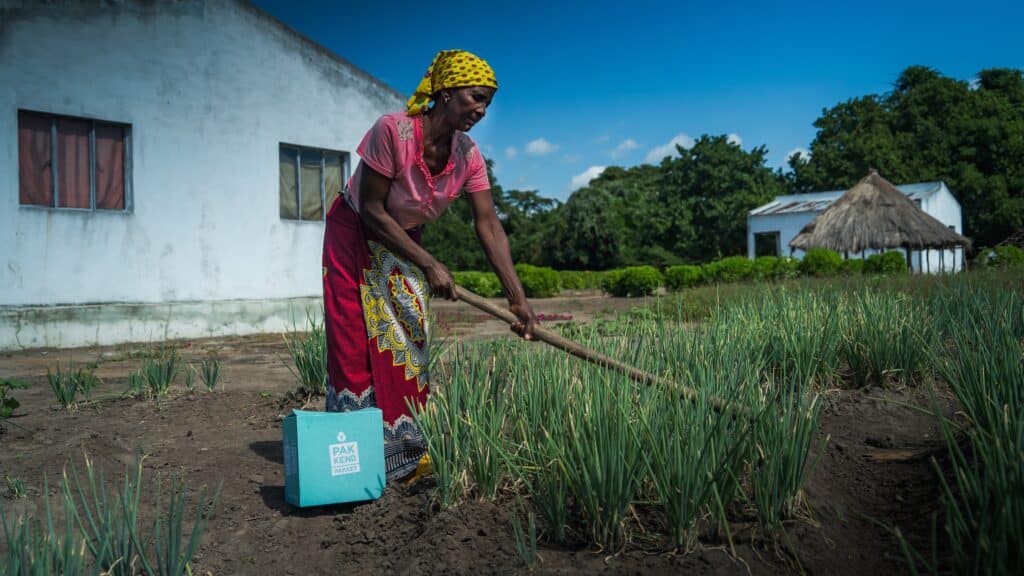
Nowadays, instead of shipping products or goods from the Netherlands, we buy them locally or support people to grow their own food. This allows us to better match local tastes and needs and support the local economy. And it’s much more sustainable.
It took some time to get used to, buying a symbolic parcel rather than a tangible bag of rice, pasta or canned vegetables. But it’s a great example of how, as a humanitarian organisation, we continue to learn and innovate to ensure the quality of our work and have the greatest possible impact for people in need. This new way of donating food parcels is actually much more effective, and that’s what it’s all about in the end!
If you want to support the Dorcas Food Campaign after reading this column, the national action week is about to start. And if you don’t see us in your local supermarket, a donation can be made in a flash using the QR code.
Agnes Kroes is CEO of Dorcas. Agnes: ‘I contribute with great dedication to our mission in creating opportunities for people and communities to flourish. One of the ways I do this is through a monthly column in Dutch newspaper Nederlands Dagblad. In this column, I share insights from my professional experience at Dorcas. My aim is to inspire, inform and encourage readers to engage with Dorcas’ initiatives, campaigns, and projects.‘
Kitui County, one of Kenya’s semi-arid regions, is facing severe challenges from climate change. Rising temperatures, erratic rainfall, prolonged droughts, floods, and invasive species are taking a heavy toll on the region’s ecosystems and livelihoods. With agriculture and natural resources under increasing strain, many residents have turned to activities such as tree logging and charcoal burning, further exacerbating land degradation and deforestation. These unsustainable practices have created a vicious cycle of environmental decline, making it critical to take action.
In response, Dorcas Kenya, in collaboration with Muangeni Rural Development Programme, launched the Kitui Climate Change Project in 2020. This initiative aims to enhance the climate resilience of communities through comprehensive interventions, such as behavior change, policy advocacy, and ecosystem restoration. The project aligns with global sustainability goals, including SDG 13 (climate action), SDG 1 (no poverty), and SDG 2 (zero hunger), promoting sustainable development practices to safeguard the future.
Afforestation efforts through schools
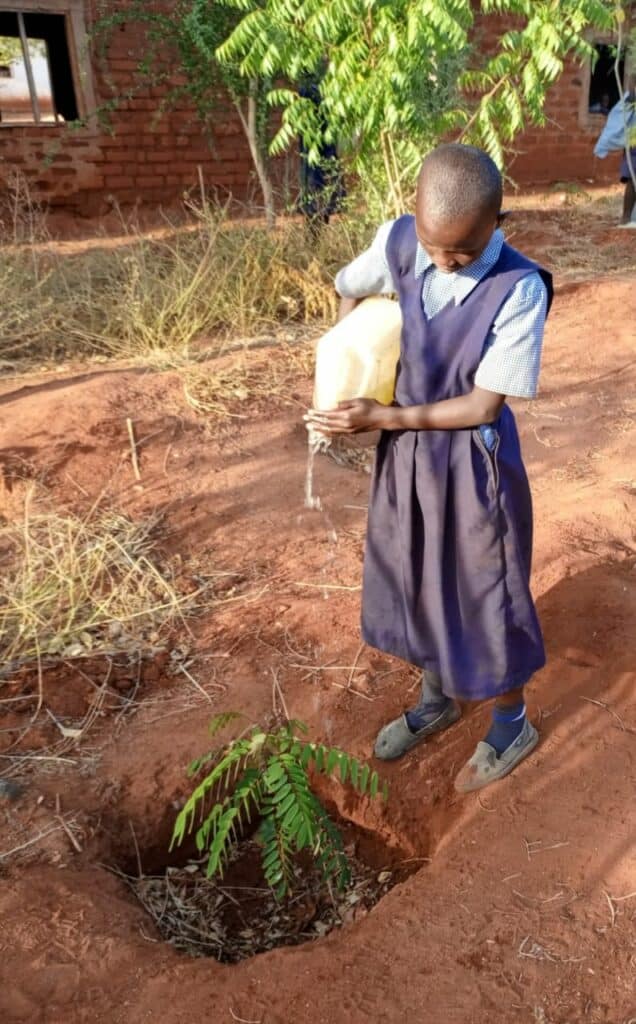
A key element of the Kitui Climate Change Project is afforestation, carried out through schools in the region. Since 2021, over 150 schools in Kitui South have participated in the tree-planting initiative, which is designed to address water scarcity challenges while fostering environmental stewardship among students. Tree planting is strategically aligned with the short rain season (October, November, December) when the climate is more stable, ensuring the newly planted trees benefit from two rainy seasons and thus have higher survival rates.
Under the slogan “A Child, A Tree,” each student is encouraged to adopt and care for a tree for a full year. This approach not only fosters environmental responsibility among the younger generation but also ensures that the trees are well-maintained. Each school receives 100 seedlings annually and, upon successfully nurturing them, qualifies for additional seedlings in subsequent years.
Notable success and impact
To date, the project has seen the survival of approximately 36,000 out of 55,000 trees planted between 2021 and 2022, representing a survival rate of 65-70 per cent. Schools like Athi Primary now boast over 300 thriving trees, thanks to the commitment of students, who even carry water from home to ensure their survival during dry spells. Additionally, Dorcas has invested in infrastructure like a 50,000m³ water pan at Kiange Mixed Secondary School to provide a reliable water source during droughts.
This afforestation initiative not only contributes to Kenya’s national goal of planting 15 billion trees by 2032 but also plays a crucial role in restoring degraded landscapes, reducing biodiversity loss, and promoting decarbonisation. By involving school children, Dorcas is inspiring the next generation of conservationists, ensuring that the fight against climate change continues for years to come.
Through such innovative projects, Dorcas Kenya continues to foster sustainable development and climate adaptation in regions that are vulnerable, empowering communities to build a more resilient and environmentally conscious future.
Written by: Agnes Kroese, CEO of Dorcas
I don’t cry easily, but the tears were close during the online meeting with my colleagues in Lebanon. The desperation they are in, their worries and hopelessness, I could feel them even through the screen. They are frightened, anxious, but also frustrated. Frightened and anxious about their own safety and that of their families. Frustrated because the resources to provide assistance are limited, while the need is so great. There is also frustration because they feel that the suffering currently taking place in Lebanon is not being noticed by the rest of the world. That the international community is turning a blind eye and remaining silent.
I recognise this because I see the same in the Netherlands when it comes to collective outrage about how innocent civilians are being forced to flee violence in haste. But, upon reflection, perhaps it’s not entirely accurate to speak of silence. Loud and clear are the negative reactions we at Dorcas received (and continue to receive) in response to the emergency assistance campaign for Lebanon.
Don’t misunderstand me: we’re not surprised by angry reactions. There are always people who are critical. It’s okay to be critical—I have absolutely no problem with that. I also understand that the situation in the Middle East is sensitive, and I realise that opinions differ widely, especially, or perhaps particularly, within Christian communities in the Netherlands. But the way some people feel the need to express their opinions—I do have something to say about that.
It has now even reached the point where, for the first time, we have had to stop a campaign on social media because of hateful comments. What also stood out was that we weren’t just receiving such responses online. Even in phone calls and emails from our own supporters, things sometimes got heated. A call to donate for emergency assistance doesn’t need to be an invitation for outright hurtful communication.
I enjoy a robust discussion and am open to critical questions, but with respect for one another. And what I’ve thankfully also often heard and seen happen in the past week is that people become more understanding when we explain why we do what we do. We’ve been working in Lebanon for over thirty years and have a large network within the Christian community. This allowed us to act quickly.
Dorcas is active in 14 countries, and when a crisis occurs in one of these countries, we roll up our sleeves. We will continue to do so, even when it’s difficult. We don’t choose political or theological sides. If we choose any side, it’s the side of the person in need.
Agnes Kroes is CEO of Dorcas. Agnes: ‘I contribute with great dedication to our mission in creating opportunities for people and communities to flourish. One of the ways I do this is through a monthly column in Dutch newspaper Nederlands Dagblad. In this column, I share insights from my professional experience at Dorcas. My aim is to inspire, inform and encourage readers to engage with Dorcas’ initiatives, campaigns, and projects.‘
Written by: Agnes Kroese, CEO of Dorcas
Perhaps you have seen it: our campaign for safe shelter in Lebanon. Our local colleagues are working hard to support displaced people fleeing the conflict, providing them with shelter and basic necessities.
We are receiving responses to the campaign. Some are negative, questioning why we are not offering assistance to people in Israel. We engage in conversation with these individuals, and fortunately, we receive understanding when we explain. We also get many positive responses and donations, for which we are very grateful.
However, we have noticed that it is relatively silent. Even though Lebanon is in the news. Dutch news site NOS headlines that almost half a million people are now on the run. Half a million people! But it seems like it has not got through to us. That it is not affecting us. We are not receiving the response we are used to for a campaign like this.
It is understandable. When we talk about the situation in the Middle East, and particularly in Lebanon at this moment, we are also talking about Israel. Opinions, even within the Christian community in the Netherlands, are sharply divided on this issue. This makes it a difficult, sensitive, and emotional topic at times. And on top of that, we are confronted with so much violence and suffering on a daily basis. All over the world there are people in need, nearby and far away.
It is overwhelming. So much to take in, to have an opinion on, and to be touched by. Right or wrong, it is sometimes very complex. However, that is not the point I want to make. What is most important to me, and to Dorcas, is that we want to be there for people in need. Impartial and regardless of one’s background. I want to invite you to join us.
I would like to ask you to be mindful on your fellow human beings in need. Like those in Lebanon right now. People, just like you and me. Notice the scared child in her pyjamas. She was woken up early and has already been stuck in traffic all day. The mother, near despair, because she has already lived through war. The grandfather, praying that his grandchildren will remain safe. This images, those stories about people in fear and need—these leave me speechless and silent.