More than 3.4 billion euros will be cut from the Dutch budget for development cooperation and humanitarian assistance in the coming years if the government’s “spring budget” (Voorjaarsnota) is approved. As more asylum seekers than expected are coming to the Netherlands, the government intends to use these funds from the development cooperation budget to provide housing for these asylum seekers within Dutch borders. This money would otherwise be spent on sustainable development and humanitarian assistance throughout the world. Over 100 Dutch development organisations, including Dorcas, are therefore calling for these cuts to be reversed and for the setting of a maximum amount for the asylum costs paid from the development cooperation budget.
Partos, the umbrella association for more than 100 Dutch development organisations, considers it very ill-advised that the Dutch government will cut back on tackling the root causes of conflict, climate change, poverty and humanitarian assistance. It therefore calls on the Dutch House of Representatives to reverse the budget cuts.
Liana Hoornweg, director of Partos: ‘Of course, the Netherlands must provide adequate asylum for refugees. However, the painful fact is that standard asylum has been subject to budget cuts for many years. As expensive emergency shelter is now being deployed, the very poorest in the world are the victims of a failing Dutch asylum policy. We call on the Dutch House of Representatives to tackle this problem structurally: introduce a maximum amount for the asylum costs that can be paid from the budget for development cooperation. That will allow the development budget to be used for its intended purpose: promoting sustainable development by tackling the root causes of conflict, climate change, hunger and poverty.’
Spokespersons from the coalition parties CDA, D66 and ChristenUnie confirmed the undesirability of increasing contributions from the budget for development cooperation to fund expenditure on housing for asylum seekers. Party congresses of D66 and CU adopted motions in 2022 to set a maximum amount from the budget for development cooperation that can be used on costs for asylum. Hoornweg: ‘Now is the time for action. We are counting on the coalition parties to stick to their own statements in the coming weeks. The debate on humanitarian assistance on 11 May is a good next opportunity to do just that.’
The situation in Sudan and South Sudan continues to worsen as thousands of people flee the conflict in Sudan and cross the South Sudanese border. Dorcas shares the worries of the NGO community of South Sudan that the number of returnees and refugees is exceeding previous projections, as the number is already over 50,000. This adds to the dire humanitarian crisis South Sudan is already in. The start of the rainy season will also have a major impact on the area. The situation can become even more catastrophic, as El Niño is predicted, and this may cause heavy rain and floods.
Together with the humanitarian community in South Sudan, we want to raise awareness to the humanitarian crisis that is unfolding in the region. In order to mitigate an even bigger crisis and support those in need, we need to respond now. Humanitarian supplies and especially food items need to be supplied to prevent the severity of food insecurity in the region to worsen.
Soon the Dutch Ministry of Foreign Affairs will present its “Feminist Foreign Policy”. Following in the footsteps of countries such as Spain, Sweden and Canada, the Netherlands will commit itself to fostering global equality. This will be done through the adoption and implementation of a feminist foreign policy. What this policy will entail in concrete terms is not yet known, but it seems that two target groups in particular will receive extra attention in Dutch foreign policy: (young) women and LGBTIQ+ people. The feminist foreign policy aims to serve the goal that “If more people get equal opportunities, that contributes to a safe, stable and prosperous world” (quote from the website of the Dutch Ministry of Foreign Affairs).
At Dorcas, we think it is a good development that the Netherlands is willing to target people that need extra support. For example, we know that women can be more vulnerable to poverty and exclusion for various reasons. It is important to take this into account in Dutch foreign policies, so that women worldwide receive the support they need. This also applies to LGBTIQ+ people. We therefore understand the desire to focus on equal rights for women and LGBTIQ+ people. However, Dorcas and 25 humanitarian assistance and development organisations fear that other groups of people, such as older persons, people with disabilities and ethnic minorities will automatically receive less attention. Dorcas cannot agree to favouring one person over another. This would undermine the goal of a “safe, stable and prosperous world”.
Dorcas stands for inclusive policies and practices in which everyone can participate regardless of ethnicity, gender, religious background and other personal characteristics. That is why Dorcas in collaboration with 25 organisations has written a letter to the Dutch Ministry of Foreign Affairs. In this letter we jointly request attention for an inclusive foreign policy that takes into account all personal characteristics that could lead to exclusion. As far as Dorcas is concerned, this goes beyond gender and sexual preference alone.
The letter includes suggestions on how the Dutch feminist foreign policy can broaden its scope beyond gender and sexual orientation. Often the overlap between different personality traits creates extra vulnerability. For example, women with a disability are more vulnerable than men with a disability. By recognising this overlap and looking beyond gender and sexual orientation alone, the 26 organisations hope that the Netherlands can make a difference worldwide for everyone in need!
What is a Feminist Foreign Policy?
The Netherlands wants to reduce inequality and strives for equality between men and women and LGBTIQ+ people all over the world. That is why the Ministry of Foreign Affairs is working on feminist foreign policy.
With the choice for a feminist foreign policy, equal rights and equality for women and LGBTIQ+ people will be central to all aspects of Dutch foreign policy. With this, the Netherlands joins a group of frontrunners from countries that are committed to gender equality internationally, such as Germany, Spain, France, Luxembourg, Canada, Mexico and Chile.
Dorcas distributes food, provides health support in a mobile clinic and offers psychosocial support to those affected by the earthquake. Dorcas’ humanitarian assistance coordinator Mirian Wester explains this protection approach that psychosocial support is part of.
‘Surviving an earthquake is incredibly intense’, explains Mirian. ‘It can cause a lot of stress and feelings of insecurity, which can ultimately cause a range of other complaints. Many people have been pulled out from under the rubble, and everyone has lost family and/or friends. On top of that, many people lost their homes, possessions and income in one fell swoop. That obviously has a huge impact on their lives.’
Food and water are basic needs, but so is good psychological help. Difficult experiences need to be processed as soon as possible. Many people are resilient and can talk to friends or family about their feelings and fears. Others need professional support and Dorcas provides that.
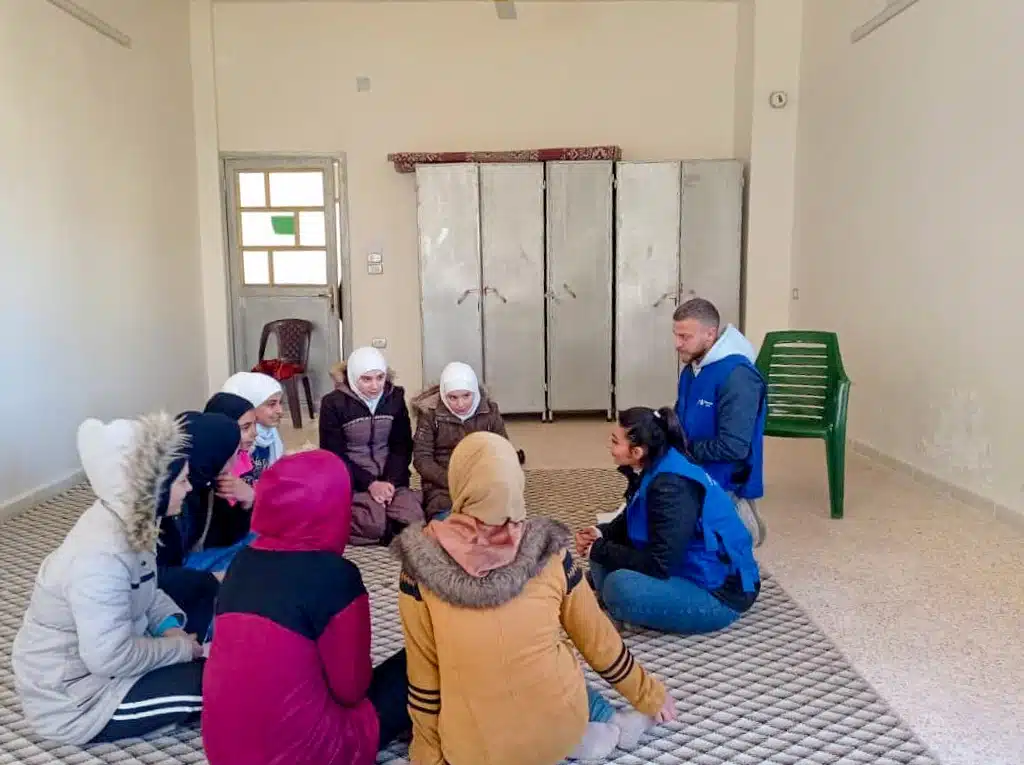
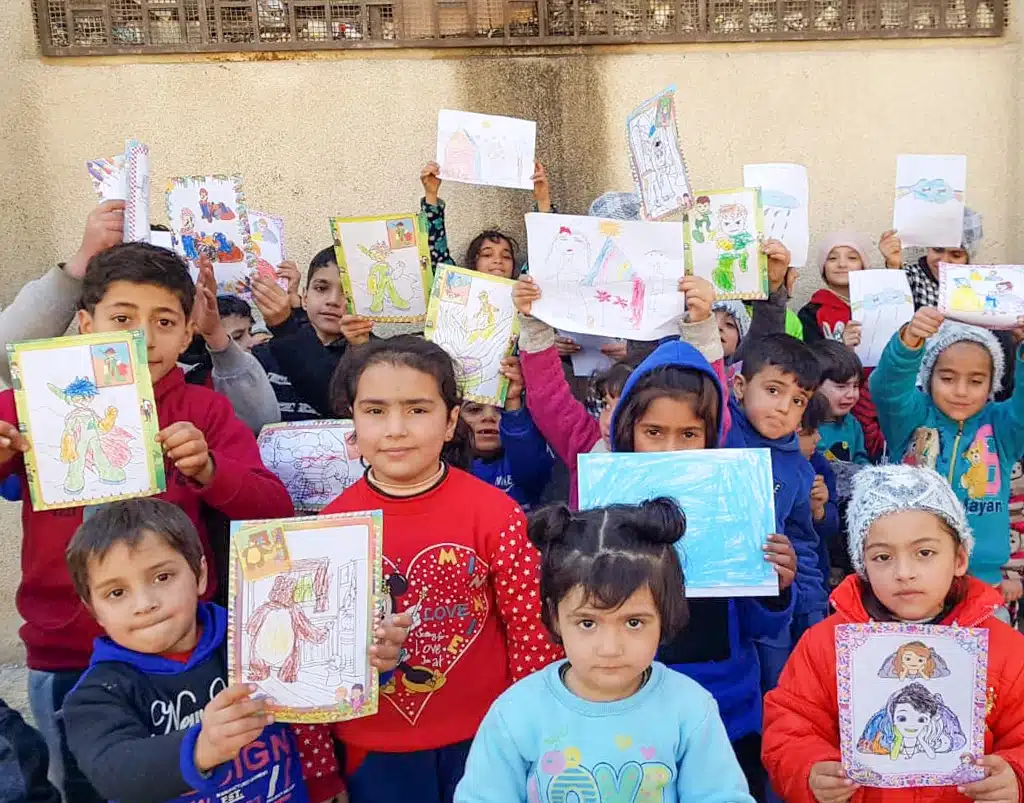
The Dorcas mental health and psychosocial support team in Syria consists mainly of social workers and psychologists, each with their own expertise. For example, some employees are specialised in giving psychosocial support to children. Providing timely help to children is extremely important. If an intense experience is not processed properly, they can carry it with them for the rest of their lives’, says Mirian. Dorcas therefore focuses on psychosocial support for children. The Dorcas Community Centres offer recreational activities to help children feel safe and relaxed and regain their self-confidence. For example, children can colour in pictures or play football with each other. Individual psychosocial sessions are possible, if a child requires specific attention.
Dorcas also organises psychosocial support for adults. This support helps them to cope with the impact of the earthquake, increase their resilience and deal with their experiences in a positive way.
Dorcas also organises awareness sessions about what people can do during and after earthquakes and about the different emotional reactions such a situation can evoke. They then learn how to deal with their reactions, for example, through breathing exercises. Individual psychological sessions are also available for adults.
Currently Dorcas provides support in 13 community centres and temporary shelters. Psychosocial activities take place In the community centres and in the temporary shelters Dorcas distributes food together with local partner organisations. Dorcas social workers visit reception locations and can refer people to the specialised psychosocial support in the centres.
Before these activities started, Dorcas first of all ensured that its staff received psychosocial support to cope with their own experiences. ‘EMDR group sessions and individual sessions were offered by our psychologist from Lebanon, who was on site immediately after the earthquake.’ Many members of staff took advantage of these sessions. Furthermore, the psychologist also gave staff a refresher course on how to give psychological first aid: calming and supporting people by showing empathy, listening and offering practical help, such as access to food. All staff distributing food or collecting data can give this first aid.
A coordinator specialised in psychosocial health is available to all staff to check on everyone’s progress. Mirian: ‘We are very aware that our colleagues were also affected by the earthquake and so we make sure that they get the help they need.’
In Syria, the earthquake caused widespread destruction in infrastructure and civilian buildings in Aleppo, Hama, Idleb, and Lattakia governorates. The impact of this earthquake is enormous. Many buildings in the region who have already suffered damage from the ongoing civil war are now destroyed.
When time passes by, we get more insight on the impact and fear that the biggest disaster is yet to come. After assessments we see:
- Many buildings have collapsed and people are still expected to be under the rubble. Many buildings are unsafe and the risk of collapse is high. In Aleppo, areas are closed due to safety reasons and providing humanitarian assistance is challenging.
- People stay on the streets, in cars, shelters, sports stadiums, mosques and churches. But there are also people who, despite the unsafe state of their homes, do not dare to leave.
- Another disaster is unfolding whilst people have lost everything and many of them do not have the means to provide in basic needs.
- The availability of essential products is limited. Shelters cannot always offer warm clothes, food and water. Given the temperatures, especially at night, it is urgent that people have access to a safe and warm place to stay.
- Syria is in a fuel-crisis and fuel is not always available or affordable. An immediate emergency demand for petrol is requested to support rescue workers and humanitarian organisations.
- Mental health and psychosocial support is essential when dealing with crisis. The continuous aftershocks are causing widespread fear and anxiety among children, older people, women and young people.
Dorcas has been active in Syria for many years. This allowed our staff on the ground to take immediate action. Dorcas is providing support on FSL, non-food items and protection via:
- Delivering food parcels and ready-to-eat meals.
- Supplying blankets and warm clothing.
- Providing health and mental health services and medicine through a mobile unit in Hama and Idleb. Its servicing in hard-to-reach areas.
- Offering mental health and psychosicial support. Our Psychological First Aid programme is designed to provide emotional support and support individuals cope with their negative experience.
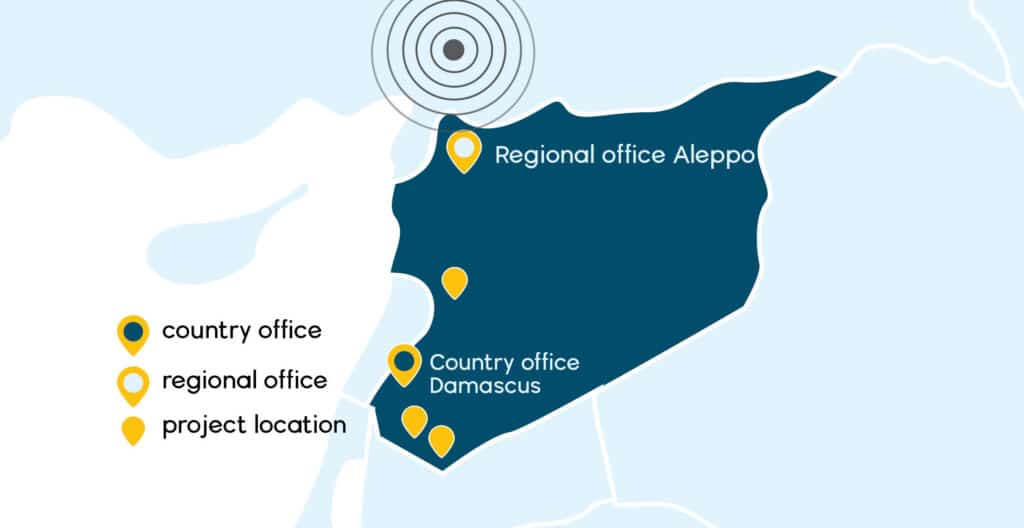
Earthquakes and severe aftershocks are causing great devastation in Syria and Turkey. Dorcas has been active in Syria for many years and is directly experiencing the consequences of this disaster itself. The office in Aleppo was heavily damaged. But country office staff took immediate action, offering support to victims based on what is needed. Blankets, warm clothes and food are currently being distributed.
Najla Chahda (Dorcas’ Country Director in Syria): ‘Our office in Aleppo is damaged and we cannot work there at the moment. It is unsafe. Luckily, we can operate from one of our partners office and continue to provide support to those in need. Our community centre, where many of our programmes are given, is unharmed. For us, it is not a question of taking action. It is in our hearts to support people and that is what we are doing now. We have to do this.’
Due to the Beirut blast, Dorcas has experience in quickly responding to a disaster of this magnitude. The situation and needs of the people who have been affected are continuously assessed. Slowly the situation is becoming clearer, but it remains to be seen whether there will be new earthquakes and how severe they will be. We see older people are unable to leave their homes and when they do, they have nowhere to go. People are afraid to stay indoors, but the current weather conditions make this challenging. Besides distributing clothes, blankets and food, Dorcas also provides first aid to the victims through a mobile clinic. Furthermore, Dorcas is looking into providing cash-money assistance and psychosocial care.
Dorcas is proud to announce that we have undergone verification against the Core Humanitarian Standard (CHS) by the independent auditing body HQAI. The process gives confidence to affected populations, donors, the public and other stakeholders that we are continuously improving the quality and accountability of our services. Quality and accountability are at the heart of our activities and this three-year process will help us assess and ensure the quality of our work, reduce the risk of mistakes and continuously improve our services – for the benefit of our organisation and, not least, the people we work for.
HQAI auditors measured whether Dorcas makes continuous progress in applying our CHS Commitments. The audit included a thorough process of document checks, reviews of practices as well as interviews with staff, affected communities and other local stakeholders.
The audit was an excellent opportunity for us to get insight in our strengths and weaknesses regarding CHS, and how we can further improve. The independent verification gives assurance that Dorcas is continuously improving its programming and operations. Based on the audit, Dorcas is able to further improve its commitment to quality and accountability for the benefit of those in need.
About Core Humanitarian Standard:
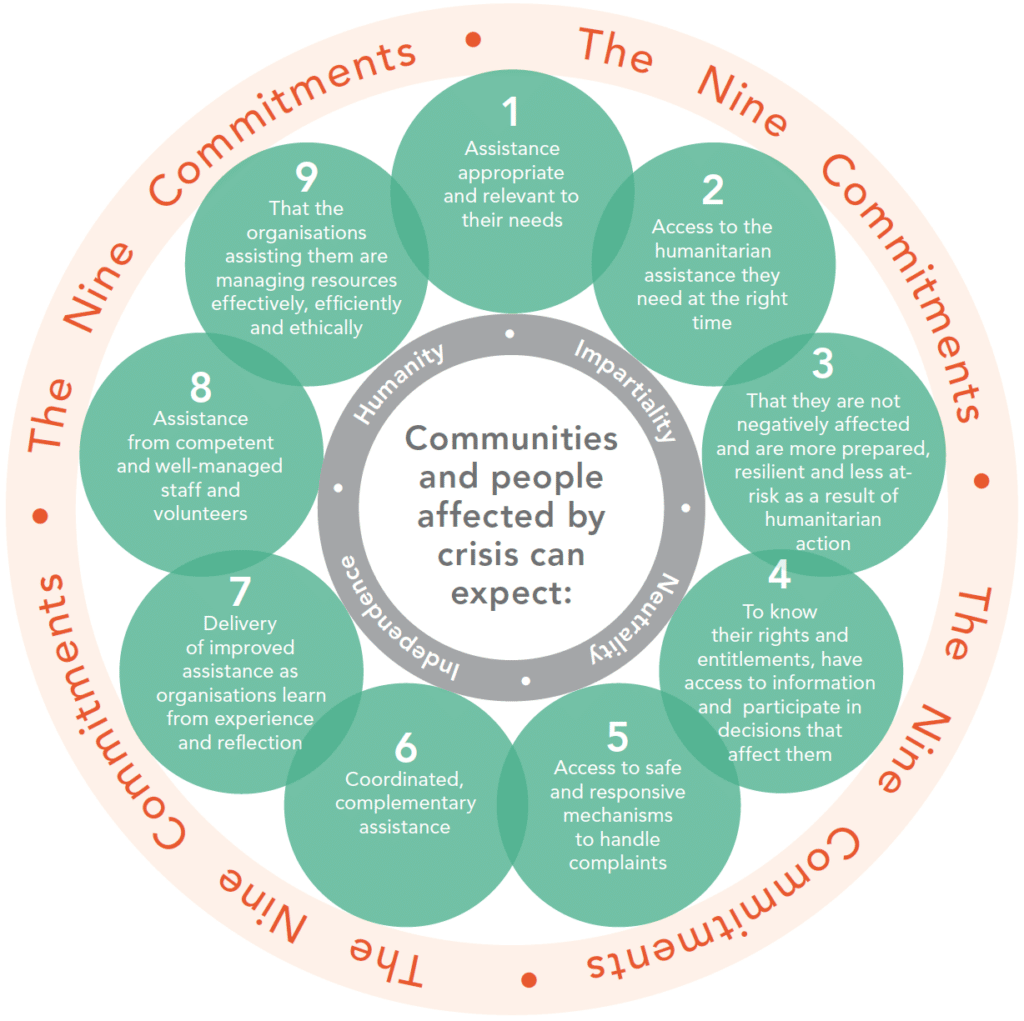
The Core Humanitarian Standard on Quality and Accountability (CHS) is a globally recognised voluntary standard that sets out Nine Commitments that organisations and individuals involved in humanitarian response can use to improve the quality and effectiveness of the assistance they provide.
The CHS places communities and people affected by crisis at the centre of humanitarian action. As a core standard, the CHS describes the essential elements of principled, accountable and high-quality humanitarian aid. It is a voluntary and measurable standard. The CHS is the result of a global consultation process. It draws together key elements of existing humanitarian standards and commitments.
After 6 months of full-scale conflict in Ukraine, millions of Ukrainians remain in immediate need of support. Across the country, the Dutch Relief Alliance (DRA) has worked together with local partners as part of its Joint Response to provide food and non-food items, multi-purpose cash assistance, and mental healthcare and psychosocial support to vulnerable households affected by the conflict.
In March, the situation across the country was opaque. There was a huge humanitarian need, but it was unclear where this need was concentrated and where help would be most effective. DRA partners hit the ground running, supporting people where they could. After a few weeks, the partners mapped where they could most effectively help out, scaling up relief efforts. Regrettably, violence continues in parts of the country. Elsewhere, communities have settled into a sort of status quo. The basic needs remain: millions of displaced people need all kinds of help, and the country needs a shift towards reconstruction.
Multi-purpose cash to meet urgent needs
Save the Children works together with Avalyst as part of the Ukraine Joint Response. Across the country, in areas including Dutska, Luhanska, Dnipropetrovska and Vinnytsia, Save the Children and Avalyst provide multi-purpose cash and non-food item kits. In the past 6 months, they were able to meet the immediate needs of more than 500 households.
Avalyst took on the responsibility of registering households, creating an inventory of their needs. After registration, Save the Children took care of cash disbursement, enabling families to determine their own spending on their immediate needs.
Next to non-restricted cash, Avalyst also distributed non-food items, handing Ukrainians in need things like basic hygiene materials, textile, and household goods. In this way, Avalyst and Save the Children help refugees and households to re-establish a semblance of their home routines.
By working together and communicating clearly with local communities, Save the Children and Avalyst have been able to adjust their aid provision to what these communities need. These strong links resulted in more efficient distribution and helped to avoid wasted goods.
Caritas Ukraine, Cordaid’s local partner in the Joint Response, has chosen to focus on distributing non-food items and hygiene kits. In areas around Dnipro and Kyiv, as well as in Ivano-Frankivsk, Caritas found that internally displaced people were most urgently in need of physical items that they lacked access to. Through its dioceses across these areas, Caritas provided emergency food packages, drinking water, warm kits and medical supplies.
Displacement, rising prices, growing needs
In Muchacova a town of 75.000 inhabitants where New Beginning works, an additional of 26.000 refugees from other parts of Ukraine have arrived – including many families with vulnerable children. New Beginning has been a partner of Dorcas for years, focusing on marginalised children. With the start of the Ukraine Joint Response in March, Dorcas and New Beginning have strengthened their partnership to meet the basic needs of refugees, providing food parcels and psychosocial support.
Internally displaced people (IDPs) get to know New Beginning when they come for food support or clothing. Through this first connection New Beginning is able to ask them their needs. IDPs are welcomed to join activities that incorporate elements of psychosocial support. Only 2% of IDPs ask for psychosocial support themselves because of feelings of shame and the taboo on mental health struggles. Good experiences with the children’s clubs lead IDPs to encourage their friends to participate, enabling more children to receive psychosocial support.
New Beginning offers a range of social activities, like a 5-day camp for children and a weekly children’s’ club. While the children play and take part in activities as part of the club, the parents – mainly mothers – go upstairs to have their own meeting and build connections with each other.
According to Alexandra, the Director of New Beginning, “if parents are at rest and show peaceful behaviour, children also develop healthy habits and feel less anxious. We focus firstly on the basic needs and on the parents – then by extension the children will recover. New Beginning has the aim to offer a new beginning. We follow our desire to help the people.”
Lasting partnerships
While the Ukraine Joint Response will come to an end in early September after 6 months, the partnerships established by working together will endure. The conflict rages on and needs remain. Reconstruction of communities, both in cities and in rural areas, will be a focus for the next months and years to return a sense of normality to the lives of Ukrainians.
The peer-to-peer approach under the Joint Response, characterised by trust and equal partnership, has already resulted in ideas and proposals for further cooperation after the end of the Joint Response. Working side by side to rapidly scale the response, overcoming together the myriad obstacles along the way, strengthened the abilities of both side of the partnership. Despite the formal end of the Joint Response, exchange of information, knowledge and best-practices between the Dutch and local partners will continue. Where possible, the DRA partners will support Caritas, Avalyst, and New Beginning, alongside other local partners, in their efforts to reconstruct their country.
The Dutch Relief Alliance Acute Joint Response in Ukraine is led by Dorcas in partnership with Cordaid and Save the Children, alongside a number of local humanitarian organisations. The work of the DRA in Ukraine is made possible in partnership with the Netherlands Ministry of Foreign Affairs.
As a small child, Agnes Kroese already wanted to ‘help people abroad’ and she ended up in South Sudan a few years ago. Since the beginning of this month, she is the new CEO of Dorcas. If you had told me this 10 years ago, I would not have believed you. But I am ready and looking forward to it.
Agnes is very excited to this new step and says: ‘Since my early childhood, I have felt called to dedicate myself to those in need. From close by, I have witnessed what Dorcas’ work means for people who are excluded, live in poverty, or in the midst of conflict and crisis. I have seen the glow return to the eyes of people who find themselves in the most difficult circumstances. I have seen communities flourish. That gives me hope. That motivates me. I would like to use my knowledge and experience to further develop and professionalise Dorcas, so that, together with everyone involved, we can realise a structural impact on even more lives.’
Agnes looks forward to continuing her career at Dorcas as CEO and also Chairman of the Executive Board. Agnes: ‘From close up, I have experienced what Dorcas’ work means for those in need. The change in individuals and the flourishing of communities motivates me and gives me hope. I want to use my knowledge and experience to further develop and professionalise Dorcas, so that, together with everyone involved, we can realise a structural impact on even more lives.’
Agnes studied International Development Studies, and then took a Master’s degree in Emergency Relief. In her role as Country Director South Sudan, she has been actively involved with Dorcas since 2019.
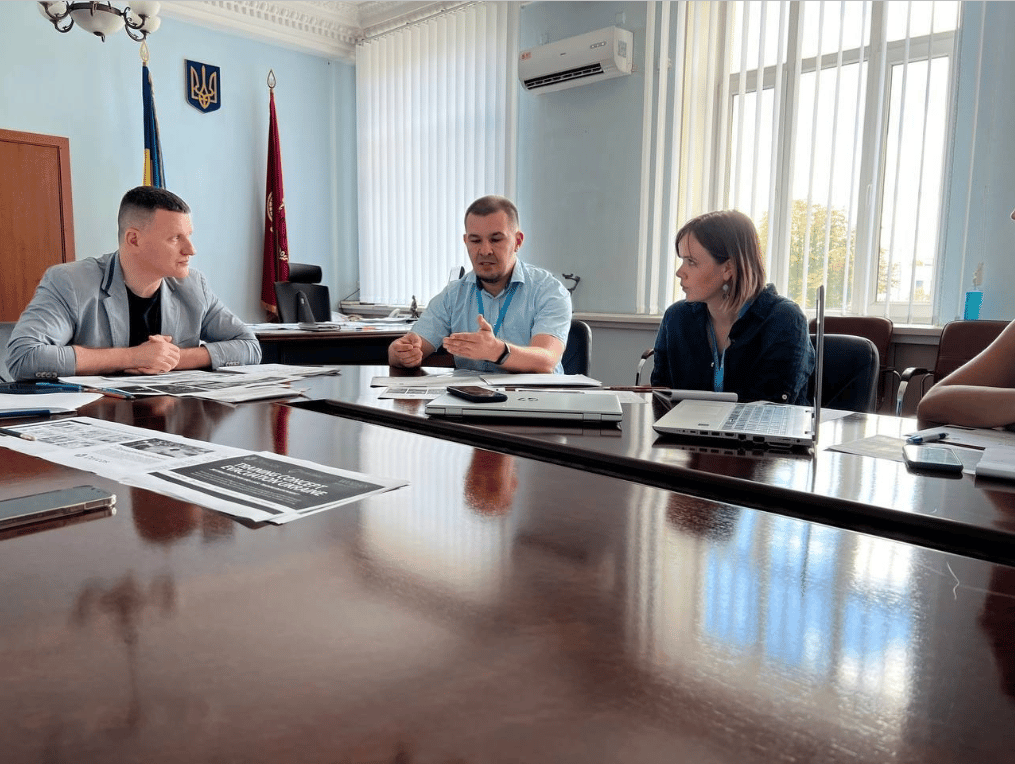
Anatoliy Kurtev, secretary of the city council in Zaporizhzhia, has announced a new information campaign for Zaporizhzhia’s residents about the procedure for emergency situations. Dorcas is one of the partners in this new project.
Dorcas, together with Wodan Security International, proposed an information campaign to prepare the local population for evacuation should the need to evacuate arise. The aim of the campaign is to enable Zaporizhzhia’s residents to act quickly and safely in emergency situations. Particular attention will be paid to vulnerable groups. As part of the campaign, instructions will be prepared that explain each phase of an evacuation, the safe routes to be followed and what needs to be in the emergency suitcase. Dorcas Ukraine will also provide hygiene kits and assist in the setting up of shelters.