Written by: Agnes Kroese, CEO of Dorcas.
The conflict in Ukraine has now been ongoing for nearly four years. For four years, people on the front line have tried to carry on with their lives while facing an ever-present threat. Sometimes, it seems impossible that things could get any worse.
During my visit to Ukraine in 2023, I witnessed the conditions on the front line up close. I was deeply affected by it. Explosions could be heard everywhere, alarms went off at night making sleep almost impossible, and you could not let your guard down for a single moment. At the same time, life goes on: people go to work, do the shopping, cook and live in their homes, even though any building could become a target. As a visitor, it felt surreal to me. But I can return to my safe home in the Netherlands. For those who live there, this is their home and their life.
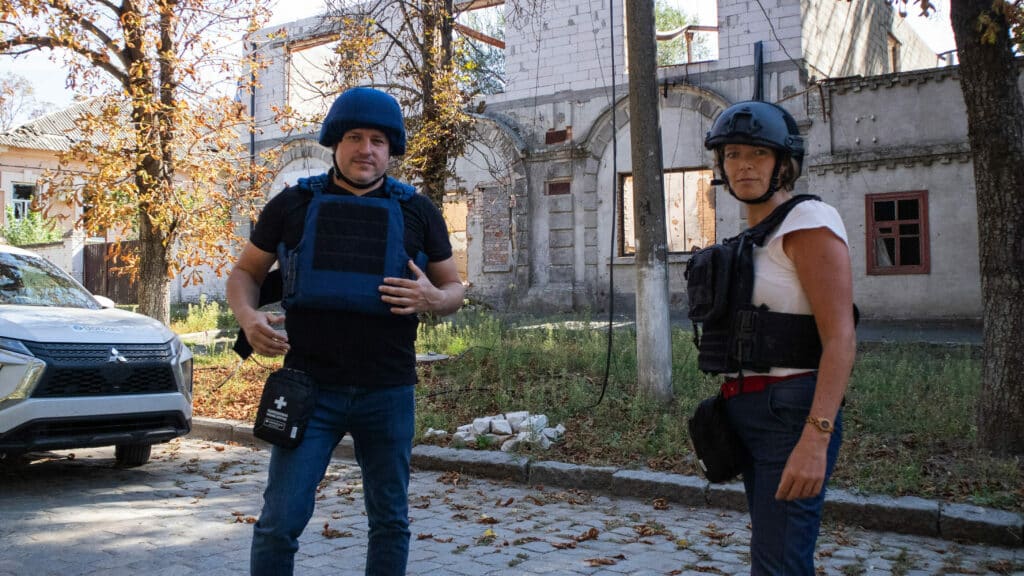
The team in Ukraine
During my visit, I became even more impressed by the Dorcas Ukraine team. Our colleagues work under constant pressure. They care for the people we support, as well as for themselves and their loved ones. The mental strain they endure is enormous, and their dedication is admirable.
It also became clear to me that destroyed buildings are not just piles of rubble. We see images on TV and feel no connection to those places. However, if you live there and have put down roots, then that is the school where you played as a child, the office where you had your first job interview and the church where you and your children were baptised and married. Everything that shapes your life is suddenly affected.
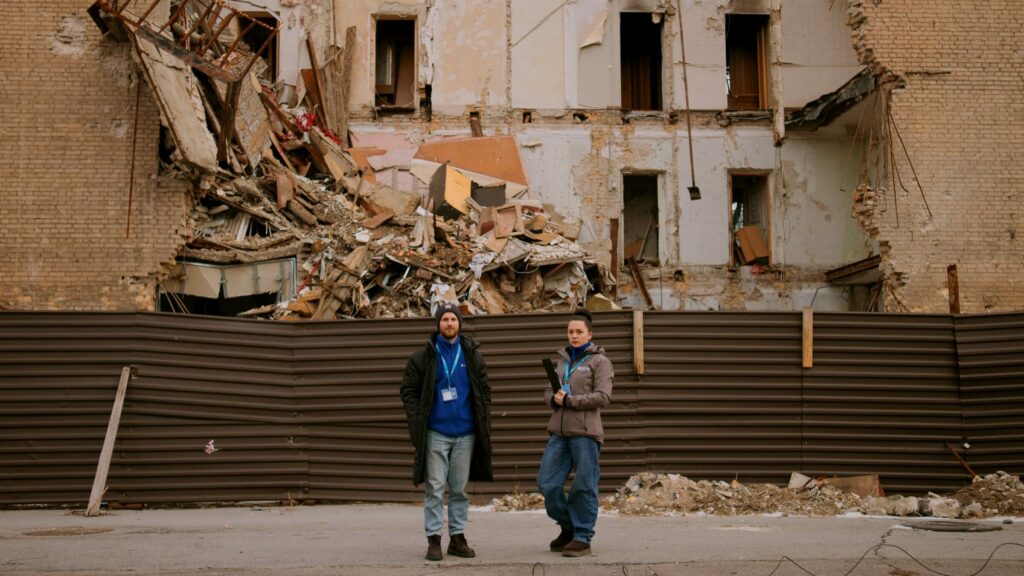
It did get worse…
This winter has been extreme. For those living on the front line, electricity can be cut off for over seventeen hours a day, while temperatures regularly plummet well below zero. The cold is exhausting and has a profound physical and mental impact. If your phone battery dies during shelling or drone attacks, it becomes almost impossible to stay in touch with loved ones, keep up to date with the news or monitor the threat level in your area.
This is where Dorcas steps in. Our emergency kits, which include a sleeping bag, a portable gas stove and a power bank, provide people on the front line with warmth and practical support in these impossible circumstances. These things may seem small, but they make a real difference.
Alongside these kits, Dorcas’s work continues: our colleagues support people every day with groceries, hygiene kits, psychosocial care and all other forms of assistance. Together with the support of everyone contributing, we can support older people and others in vulnerable situations to get through the winter feeling supported and connected.
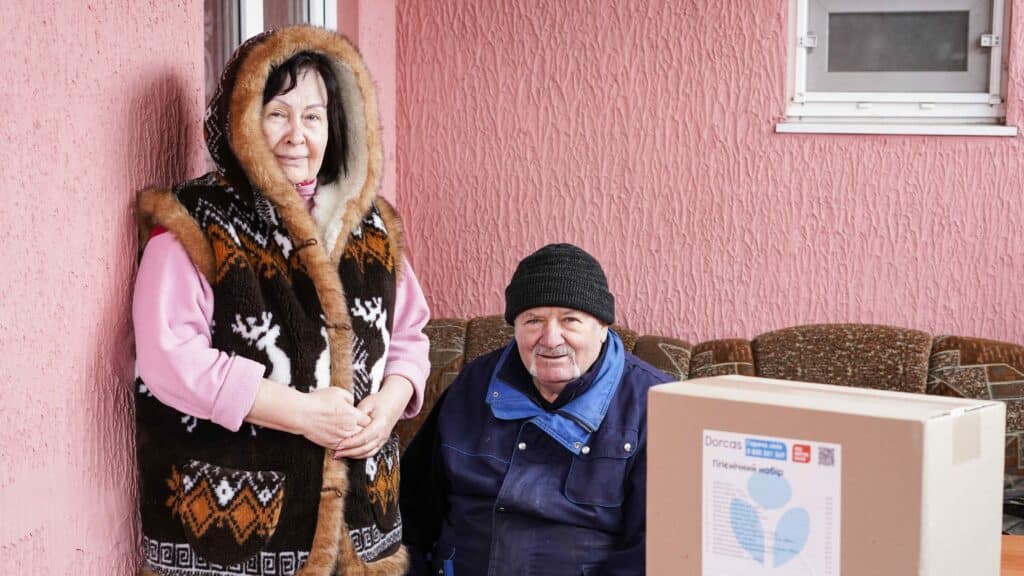
I would like to sincerely thank everyone who contributes to this assistance. Thanks to your overwhelming support, we can offer hope to those living in extreme circumstances and show them that they are not forgotten.
Donate now to support our urgent humanitarian efforts in Ukraine.
Written by: Agnes Kroese, CEO of Dorcas
I look back on the trips I have taken, one thing strikes me: hope is often found in the most unexpected places. At Dorcas, we work in some of the most difficult circumstances – situations that, from our Dutch frame of reference, we might describe as hopeless. Sometimes I feel that way too. When I see people living in shacks without clean water or other basic necessities. When I see small children wandering the streets alone in dirty, tattered clothes.
But it is in the places where I least expect it that I see glimmers of hope that never cease to amaze me. Such was the case during my recent visit to our colleagues working in the Egyptian capital, Cairo, in the notorious Mokattam district. This area is also known as ‘Garbage City’. The smell of garbage was everywhere – it seeped into every fibre of my being. I saw women and children digging through the rubbish with their bare hands, looking for something useful.
In that neighbourhood, I made my way down an alley where the garbage was piled high until I crossed the threshold of the building where we work. What I experienced inside was so different from what I saw and felt outside. The name of our project there is ‘Oasis’, and that’s what it felt like: a sanctuary of peace and safety. On the top floor I met a group of women who proudly showed me what they had made – soft toys, laptop bags and baby items such as play mats and nappy bags. Selling these items gives them much-needed extra income.
What impresses me most about hope is that it doesn’t come from being defined by your circumstances. It comes from the strength people have to find their own way – even if that way is through the rubbish. I saw it in the eyes of these women: a sparkle of pride and determination. Despite their limited resources, they have the strength to grow, to be more than their circumstances.
Also in Ukraine, I saw women who had lost everything in the ongoing conflict find hope and a renewed sense of purpose. They found the courage to rebuild their lives. What was most helpful to them? Knowing they weren’t alone. What I see again and again is the importance of being seen. That can be the most powerful source of hope. It seems like a small gesture, but by really seeing people, we show them that their situation is not hopeless, that they are not invisible. I also see how important this is for my colleagues, who often work in the most difficult conditions.
Jesus is the greatest example for me in this. He turned to the weak, to those whom society considered worthless. By seeing them, He conveyed the message that they mattered. That is the essence of hope. It’s the women in Egypt, the displaced people in Ukraine and so many others I’ve met – they find hope because they are cared for. I see pride and self-worth being restored. I see people who, however hard life may be, dare to believe in the future again.
This is what Easter always reminds us of. When all seems lost and there’s not a glimmer of hope left, it’s the power of Jesus’ resurrection that gives us the strength to get up and carry on, even in the darkest moments.
Easter is the ultimate proof that even when life seems to be taking its last breath, there are always new possibilities. With the resurrection power of Jesus within us, there is always hope. I’m grateful to be able to offer that hope, together with my colleagues, to people in need.
Written by: Agnes Kroese, CEO of Dorcas
During the Christmas season, we often talk at length about peace. But when I reflect on the year 2024, peace seems hard to find. I think, for instance, of Ukraine and the Middle East. Images of bombed-out homes come to mind, of people who have lost everything: possessions, but also loved ones. Images of children, filled with fear and despair because they had to flee for safety. And I haven’t even mentioned the many forgotten crises that barely make the news, such as the conflict in Sudan. Nowhere in the world have so many people been displaced from their homes and communities.
In a world where conflict, poverty and crisis seem to overshadow everything, peace feels further away than ever. And yet. It is precisely at Christmas that we remember how, in the midst of brokenness, God began something new. At the time of Jesus’ birth, peace on earth also seemed a distant hope. And yet God began something new in the form of a small and vulnerable Child.
‘There’s a crack in everything, that’s where the light comes in’. This line from Leonard Cohen song captures the Christmas message for me. Through brokenness, light can shine – a glimmer of hope that makes life more bearable and gives us a new perspective.
In my work with Dorcas, I see time and time again that this glimmer begins with attention. Attention that can be offered even in the midst of conflict and chaos. What makes us feel hopeless is the idea that peace only comes when a conflict ends. On a literal level, of course, that’s true. But the harsh reality is that here in the Netherlands we can rarely influence the end of conflict. What we can do is offer support, give hope and bring a little peace to the hearts of those in need.
For me, peace is so much more than the absence of bombs and the sound of gunfire. True peace starts with a small gesture. Like handing out a blanket to keep someone warm on a cold night. Offering a listening ear to someone who feels lonely. Offering a plate of food when hunger is looming.
When I look at the statistics on poverty, inequality and global crises, I get sad. It seems so hopeless. But I believe in the power of small gestures. Just like the Child of Bethlehem, who began as a vulnerable baby in a manger, but who holds the world in His hands. ‘For to us a Child is born, to us a Son is given; the government will be on His shoulders. And He will be called Wonderful Counsellor, Mighty God, Everlasting Father, Prince of Peace.’
The peace He gives, in every sense of the word, is what I wish for you this season.
Agnes Kroes is CEO of Dorcas. Agnes: ‘I contribute with great dedication to our mission in creating opportunities for people and communities to flourish. One of the ways I do this is through a monthly column in Dutch newspaper Nederlands Dagblad. In this column, I share insights from my professional experience at Dorcas. My aim is to inspire, inform and encourage readers to engage with Dorcas’ initiatives, campaigns, and projects.‘
Written by: Agnes Kroese, CEO of Dorcas
How many things have you bought this December? It’s hard to resist the temptations of Black Friday deals, ‘Sinterklaas’ discounts, and those alluring ads from clothing stores trying to dress you up in a brand-new wardrobe for Christmas.
Speaking of that new outfit, I don’t want to spoil your festive spirits, but the numbers don’t lie. Producing just one cotton T-shirt can require up to 2,500 litres of water—that’s enough for one person to drink for three and a half years! And everything keeps getting faster and cheaper. As if fast fashion weren’t bad enough, we now even have ultra-fast fashion, where clothes appear in stores within days at an even lower price.
When I think about it, I can’t help but feel a sense of unease. This can’t be good for the world. I’m not just thinking about the workers enduring harsh conditions to produce these garments but also about the planet. We’re stripping it of resources and exhausting it while the piles of waste grow ever larger. The earth has been entrusted to us to care for, not to destroy.
Treating the planet with sustainability and fairness doesn’t have to be difficult. If I could give you one tip this December: skip the fast-fashion stores and visit a nearby Dorcas shop to discover the magic of second-hand shopping. I’m still on this journey myself. I still catch myself too often buying clothes and other items brand-new, even though I know a trip to second-hand shops is far more sustainable—and often yields hidden gems. My younger sister sets a great example for me; she very consciously made the choice to buy almost all her clothing second-hand.
 Conversations with colleagues often remind me of the consequences of our actions on the earth. Droughts in countries like Kenya, Iraq, and Yemen. Or severe floods in places such as South Sudan and Ethiopia. These events have devastating consequences: people are forced to flee, or crops fail, leaving hunger lurking. By purchasing something from a Dorcas shop, you help us support people in these countries. Whether through humanitarian assistance during crises or long-term projects teaching people and communities to adapt to changing weather conditions.
And it can all start with one thoughtful purchase in the Netherlands. Let’s make the holidays a bit more sustainable together. If the (second-hand) shoe, jumper, or party dress fits, wear it—you’ll have something new to shine in and also give the earth a gift this Christmas.
Agnes Kroes is CEO of Dorcas. Agnes: ‘I contribute with great dedication to our mission in creating opportunities for people and communities to flourish. One of the ways I do this is through a monthly column in Dutch newspaper Nederlands Dagblad. In this column, I share insights from my professional experience at Dorcas. My aim is to inspire, inform and encourage readers to engage with Dorcas’ initiatives, campaigns, and projects.‘
Written by: Agnes Kroese, CEO of Dorcas
Within ten minutes, you can have your bananas, soft drinks, or dessert delivered. Just add them to your basket in the app, check out, and all you have to do is open the door for the courier, who will be there in a flash.
I have to admit that I still do my shopping the old-fashioned way, but I couldn’t help but think about the phenomenon of rapid grocery delivery while we’re working on the Dorcas Food Campaign. It’s so easy to take for granted that we can have our groceries delivered quickly, or that we can choose from twenty types of cheese or a whole range of fresh bread in the supermarket.
I still clearly remember the first time I went to a supermarket in the Netherlands after living in South Sudan for years. As I looked at shelves stacked with various kinds of peanut butter, all I could see was the image of a severely malnourished little boy sitting on his mother’s lap in one of our clinics. In many countries, it’s far from guaranteed that there will be food on the table in a flash—or any food at all. In the Netherlands, we are quite privileged, though I’m fully aware that significant disparities exist here too. Where one person can easily order only top brands, another depends on whatever is included in their food bank package that week.
At Dorcas, we are committed to supporting people in need, for example in Ukraine, Ethiopia and Lebanon. One way we do this is through the Dorcas Food Campaign. Through this campaign, we ensure that people are fed who would otherwise have to miss out on healthy food. You may have seen our volunteers in the past standing in supermarkets asking people to donate one or more food items for the Food Campaign.
Nowadays, instead of shipping products or goods from the Netherlands, we buy them locally or support people to grow their own food. This allows us to better match local tastes and needs and support the local economy. And it’s much more sustainable.
It took some time to get used to, buying a symbolic parcel rather than a tangible bag of rice, pasta or canned vegetables. But it’s a great example of how, as a humanitarian organisation, we continue to learn and innovate to ensure the quality of our work and have the greatest possible impact for people in need. This new way of donating food parcels is actually much more effective, and that’s what it’s all about in the end!
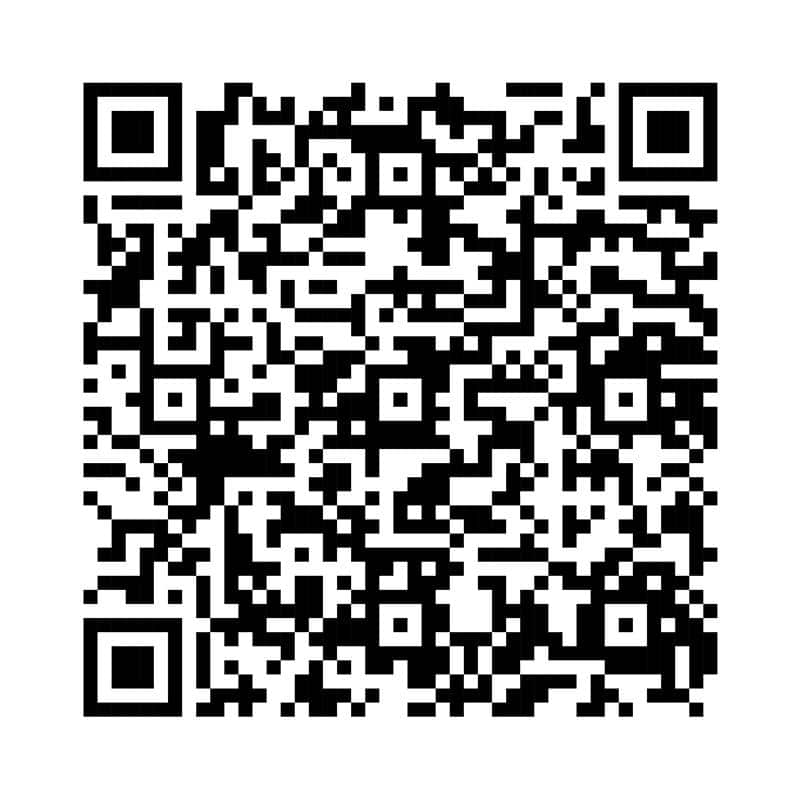
If you want to support the Dorcas Food Campaign after reading this column, the national action week is about to start. And if you don’t see us in your local supermarket, a donation can be made in a flash using the QR code.
Agnes Kroes is CEO of Dorcas. Agnes: ‘I contribute with great dedication to our mission in creating opportunities for people and communities to flourish. One of the ways I do this is through a monthly column in Dutch newspaper Nederlands Dagblad. In this column, I share insights from my professional experience at Dorcas. My aim is to inspire, inform and encourage readers to engage with Dorcas’ initiatives, campaigns, and projects.‘
Written by: Agnes Kroese, CEO of Dorcas
I don’t cry easily, but the tears were close during the online meeting with my colleagues in Lebanon. The desperation they are in, their worries and hopelessness, I could feel them even through the screen. They are frightened, anxious, but also frustrated. Frightened and anxious about their own safety and that of their families. Frustrated because the resources to provide assistance are limited, while the need is so great. There is also frustration because they feel that the suffering currently taking place in Lebanon is not being noticed by the rest of the world. That the international community is turning a blind eye and remaining silent.
I recognise this because I see the same in the Netherlands when it comes to collective outrage about how innocent civilians are being forced to flee violence in haste. But, upon reflection, perhaps it’s not entirely accurate to speak of silence. Loud and clear are the negative reactions we at Dorcas received (and continue to receive) in response to the emergency assistance campaign for Lebanon.
Don’t misunderstand me: we’re not surprised by angry reactions. There are always people who are critical. It’s okay to be critical—I have absolutely no problem with that. I also understand that the situation in the Middle East is sensitive, and I realise that opinions differ widely, especially, or perhaps particularly, within Christian communities in the Netherlands. But the way some people feel the need to express their opinions—I do have something to say about that.
It has now even reached the point where, for the first time, we have had to stop a campaign on social media because of hateful comments. What also stood out was that we weren’t just receiving such responses online. Even in phone calls and emails from our own supporters, things sometimes got heated. A call to donate for emergency assistance doesn’t need to be an invitation for outright hurtful communication.
I enjoy a robust discussion and am open to critical questions, but with respect for one another. And what I’ve thankfully also often heard and seen happen in the past week is that people become more understanding when we explain why we do what we do. We’ve been working in Lebanon for over thirty years and have a large network within the Christian community. This allowed us to act quickly.
Dorcas is active in 14 countries, and when a crisis occurs in one of these countries, we roll up our sleeves. We will continue to do so, even when it’s difficult. We don’t choose political or theological sides. If we choose any side, it’s the side of the person in need.
Agnes Kroes is CEO of Dorcas. Agnes: ‘I contribute with great dedication to our mission in creating opportunities for people and communities to flourish. One of the ways I do this is through a monthly column in Dutch newspaper Nederlands Dagblad. In this column, I share insights from my professional experience at Dorcas. My aim is to inspire, inform and encourage readers to engage with Dorcas’ initiatives, campaigns, and projects.‘
Written by: Agnes Kroese, CEO of Dorcas
Perhaps you have seen it: our campaign for safe shelter in Lebanon. Our local colleagues are working hard to support displaced people fleeing the conflict, providing them with shelter and basic necessities.
We are receiving responses to the campaign. Some are negative, questioning why we are not offering assistance to people in Israel. We engage in conversation with these individuals, and fortunately, we receive understanding when we explain. We also get many positive responses and donations, for which we are very grateful.
However, we have noticed that it is relatively silent. Even though Lebanon is in the news. Dutch news site NOS headlines that almost half a million people are now on the run. Half a million people! But it seems like it has not got through to us. That it is not affecting us. We are not receiving the response we are used to for a campaign like this.
It is understandable. When we talk about the situation in the Middle East, and particularly in Lebanon at this moment, we are also talking about Israel. Opinions, even within the Christian community in the Netherlands, are sharply divided on this issue. This makes it a difficult, sensitive, and emotional topic at times. And on top of that, we are confronted with so much violence and suffering on a daily basis. All over the world there are people in need, nearby and far away.
It is overwhelming. So much to take in, to have an opinion on, and to be touched by. Right or wrong, it is sometimes very complex. However, that is not the point I want to make. What is most important to me, and to Dorcas, is that we want to be there for people in need. Impartial and regardless of one’s background. I want to invite you to join us.
I would like to ask you to be mindful on your fellow human beings in need. Like those in Lebanon right now. People, just like you and me. Notice the scared child in her pyjamas. She was woken up early and has already been stuck in traffic all day. The mother, near despair, because she has already lived through war. The grandfather, praying that his grandchildren will remain safe. This images, those stories about people in fear and need—these leave me speechless and silent.
Read more on our response in Lebanon
Written by: Agnes Kroese, CEO of Dorcas
What do I think of the government programme? Someone asked me that this week. Due to the setting I was in, I chose my words carefully and responded diplomatically (and rather euphemistically) that I found ‘the developments concerning’. International development and humanitarian assistance are clearly being sacrificed. In reality, it deeply affects me that the concept of ‘fellow human beings’ seems to stop at our borders. And certainly, there are enough concerns in the Netherlands that demand attention, but the solution does not lie in closing our borders or, more generally, in shutting our eyes to the needs close by and far away. And thankfully, a visit to Assen earlier this week proved to me that there are more people who feel the same way.
I was in Assen for the official opening of the 44th Dorcas shop. This shop was made possible thanks to the efforts of many dedicated volunteers. What began as the initiative of a few people grew into a shop that operates five days a week, run by a group of around 100 volunteers. As I stood there, surrounded by people who consciously choose to spend their free time helping others, I thought: There you go! We have not lost our humanity after all. And thank goodness for that, because volunteers are incredibly important. Not only for Dorcas, but also for most of community life.
In sports clubs, neighbourhood associations, and churches, countless people selflessly contribute to making all kinds of activities possible. Without volunteers, society grinds to a halt. Fortunately, figures from the Central Bureau of Statistics (CBS) show that the number of people doing volunteer work has returned to pre-COVID levels. Half of the Dutch population is active as volunteers, and older people have even become more involved than they were in 2019.
It is encounters with volunteers, like the one in Assen this week, and statistics like those from the CBS that give me hope and energy. Hope and energy to keep going, against the political tide of stricter, swifter, leaner, and cutbacks. I do not want to close my eyes or look away, but to keep seeing those in need. Together with my colleagues and the thousands of volunteers who are indispensable in this.
Words that motivate me in this come from the Bible: “Love your neighbour as yourself.” Jesus shows that love (for one’s neighbour) is the essence of our human existence. Love that makes no distinction but unites. Love that spurs us on to offer support and compassion to people both near and far. When I look around, I see that, fortunately, there are still many volunteers who embody this. No government programme can compete with that.
Agnes Kroes is CEO of Dorcas. Agnes: ‘I contribute with great dedication to our mission in creating opportunities for people and communities to flourish. One of the ways I do this is through a monthly column in Dutch newspaper Nederlands Dagblad. In this column, I share insights from my professional experience at Dorcas. My aim is to inspire, inform and encourage readers to engage with Dorcas’ initiatives, campaigns, and projects.‘
Written by: Agnes Kroese, CEO of Dorcas
Of course, I’ve had some sleepless nights over the past few weeks. I would lie staring at the ceiling, feeling a knot in my stomach when thinking about what awaits us with this new cabinet. A minister who has repeatedly made it clear in the past that she is not a fan of supporting people in need. A minister who is no longer responsible for development cooperation but for development aid.
You might think: ‘What’s in a name?’ But even this name change is so telling. Where for years we have worked to move away from the ‘white saviour complex’ and have stood alongside people instead of positioning ourselves above them as a development organisation, the new name clearly signifies a step backwards. ‘Aid’ implies a power dynamic: I am the helper, you are the one in need, and soon the person who needs help is seen as weak and incapable. At Dorcas, we prefer to speak of ‘supporting,’ which is based on the strength of the people themselves. We believe in the wonderful potential that each person has received from God.
It’s not the consequences of cuts in development cooperation that keep me awake at night. We are incredibly grateful for our loyal supporters. Due to their involvement in prayer and financial support, we are not completely dependent on government subsidies. But I worry about the equality of people; I see how it is increasingly at risk. In the choice of a ministerial title, but also closer to home, around me. How people talk about each other, how relationships harden, and opinions are fired at each other like toxic arrows, without seeing the person behind the opinion.
Based on the new minister’s past, you could say that Dorcas has every reason to be suspicious. To feel abandoned as an organisation. Is what we have built over the past years now being undone? Fortunately, it’s not about us as Dorcas. It’s not about a minister and not about a cabinet that does not hold development cooperation in high regard. It’s about fellow human beings in need. Looking back at what has been is not really my thing. Looking out for people in need, wherever they are, is a Biblical command that gets me out of bed every morning. Giving them the tools to realise their own development ignites an energy in me that makes me rise with fresh courage even after a restless night.
Agnes Kroes is CEO of Dorcas. Agnes: ‘I contribute with great dedication to our mission in creating opportunities for people and communities to flourish. One of the ways I do this is through a monthly column in Dutch newspaper Nederlands Dagblad. In this column, I share insights from my professional experience at Dorcas. My aim is to inspire, inform and encourage readers to engage with Dorcas’ initiatives, campaigns, and projects.‘
Written by: Agnes Kroese, CEO of Dorcas
In recent weeks, the development sector in the Netherlands has taken several hard blows. The new plans of the future government (Hoofdlijnenakkoord) announced not only severe cuts, but also restricting tax benefits on donations to civil society organisations. I am deeply concerned about this and when I heard it, it almost hurt physically. We are on the eve of the biggest cuts in development cooperation in Dutch history. How can we continue to look at ourselves in the moral mirror when the global poverty and inequality gap is growing in the background? A gap that will not disappear by hiding behind our Dutch dikes, but that requires us to work together to tackle these problems both far away and close to home.
Besides reducing government costs, the cuts are also intended to make NGOs less dependent on government subsidies. At the same time, the new government is blocking another important source of funding, donations from individuals. Limiting the tax benefits on donations will make it less attractive for people like you to donate. Research has already shown a decline in giving, and experts predict that this decline will increase as a result of these plans.
You would expect that by restricting one, alternatives would be encouraged. However, the opposite is the case. It feels as if this is giving us one extra blow after the other. Our financial resources are being eroded, but so are the resources we can mobilise through society. It is a painful reality that may even force us to make difficult and painful choices in the future. Fewer projects, less support, less impact….
I dread to think about what this means for those in need. Like lonely older people in Albania who are not seen, children in Egypt who have no space to play, learn and develop their talents, youth unemployment in Ethiopia which remains extremely high, and there are countless other examples.
No matter how hard these government policies hit us, Dorcas remains more than one hundred per cent committed to the people who so urgently need our support. We have been doing this for almost 45 years and we will continue to do so. At a time when the world is facing so many conflicts and disasters, it is crucial to work for a more equal world. That is why we are calling on everyone in the Netherlands to continue to support relief organisations with donations, but also with time and prayer. So that we can continue to do what we do best: support people in need.
Together, let us ensure a future where we do not abandon our neighbours and those close to us, but continue to support and empower those who are struggling. Let us keep investing in hope and change. It is what the world needs, especially now!
Agnes Kroes is CEO of Dorcas. Agnes: ‘I contribute with great dedication to our mission in creating opportunities for people and communities to flourish. One of the ways I do this is through a monthly column in Dutch newspaper Nederlands Dagblad. In this column, I share insights from my professional experience at Dorcas. My aim is to inspire, inform and encourage readers to engage with Dorcas’ initiatives, campaigns, and projects.‘